War Thunder’s Nuclear Escalation Event Runs in the Vietnam Era Through September 7
The limited-time mode covers Battle Ratings 8.7-11.0 and adds Roland 1 air defenses, raised airfield platforms, and maximum-skilled crews for nuclear-capable aircraft.

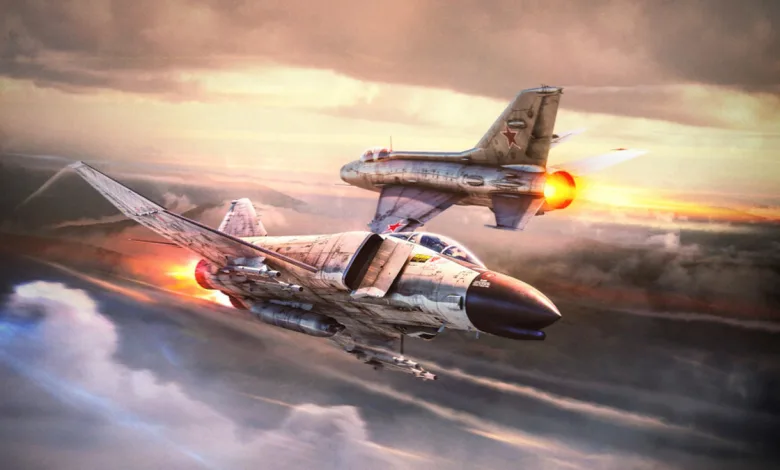
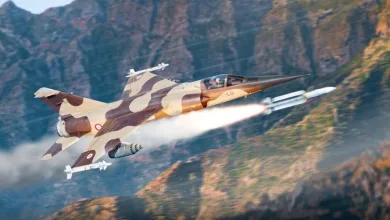
War Thunder’s Nuclear Escalation mode is available from September 2 at 13:00 GMT through September 7 at 13:00 GMT, returning its aircraft battlefield to the Vietnam era for Battle Ratings 8.7-11.0. Players can find the event in the Events and Tournaments tab, where MiG-21s face F-105s and Shrikes go up against S-75s in a hypothetical conflict involving nuclear weapons.
Gaijin Entertainment details the limited-time rules and revisions in its Steam announcement. Recent mode revisions also added the 8.7-9.7 and 10.0-11.0 Battle Rating brackets while reworking defensive positions in Update 2.57.1.126.
Vietnam-era objectives go beyond air combat
Nuclear Escalation asks players to affect the wider operation instead of focusing only on enemy aircraft. Depots and convoys can be destroyed to cut supply lines, while airfields, artillery, and tactical ballistic missile systems remain important targets. Pilots can also suppress medium- and long-range anti-aircraft positions, attack a carrier fleet and its escort, and fight for air superiority. Unlimited spawns keep aircraft returning to the battle after they are lost.
Roland 1 missiles replace Rapier systems
Every Rapier surface-to-air missile system in the mode has been replaced by a FlaRakPz 1 equipped with Roland 1 missiles. The change gives pilots clearer warning of incoming fire. Rapier missiles did not trigger the radar warning receivers used by aircraft in these Battle Rating ranges, and they left no visible smoke trail. Roland 1 missiles are detected by those receivers and produce a prominent trail, while their performance is closer to the Osa’s missile than to the Rapier’s.
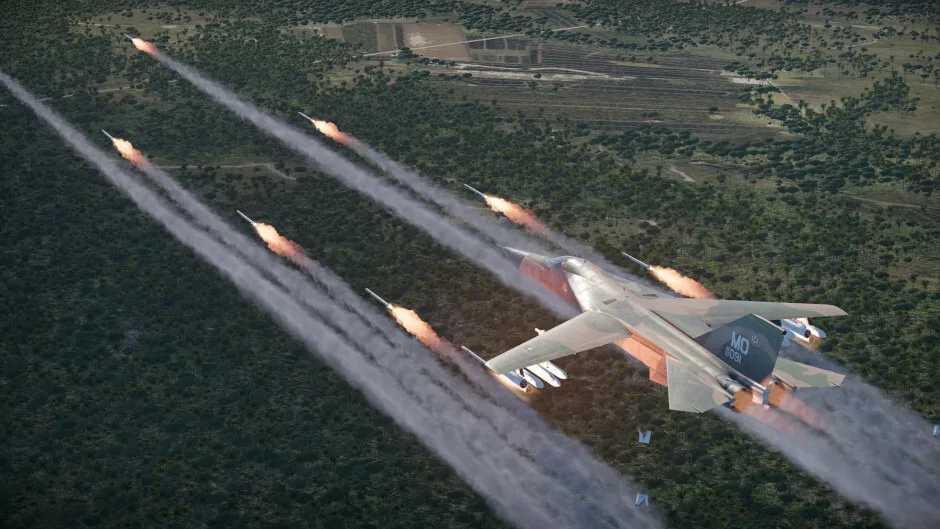
Airfield defenses in the 10.0-11.0 range have also been reinforced. One side now has three ZSU-23-4 or M163 gun-based SPAAGs alongside three Osa-AKM systems, with four missiles carried by each Osa-AKM. The opposing side receives three FlaRakPz 1 systems. The extra coverage is aimed at aircraft taking off and landing, where the previous protection could be bypassed too easily.
Tactical assembly areas use a different mix as well. An Osa-AKM carrying four missiles replaces one ZSU-57-2, and a FlaRakPz 1 with Roland 1 missiles replaces one M42 Duster. Soviet convoys now trade their single BMP-1 for another ZSU-23-4, bringing each column to two of the gun systems. The adjustment accounts for differences in the ground-attack tools carried by common strike aircraft, particularly the number of fire-and-forget guided weapons available to them.
Raised platforms protect airfield approaches
Low-altitude approaches previously made it easy to reach enemy airfields. Raised platforms for SAM units are now being added to airfields across every era of Nuclear Escalation, putting the systems higher above the surrounding terrain. Their improved line of sight provides better protection while aircraft are taking off or landing.
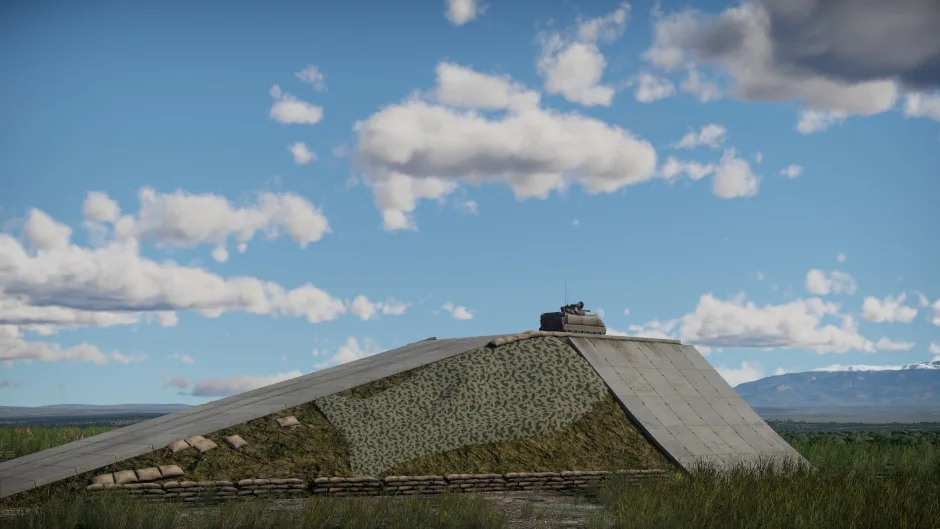
The map’s vegetation has been adjusted to make ground targets easier to reach. Forest density is lower, and vegetation along roads is shorter, giving attackers a clearer path toward vehicles moving through those areas.
Nuclear aircraft crews start fully qualified
Crews assigned to every nuclear-capable aircraft now have maximum skill levels and Expert qualification. That applies across the mode, so pilots do not need to account for lower crew training when a nuclear-capable aircraft becomes available during an operation.
With the event running through September 7 at 13:00 GMT, the Vietnam-era setup puts missile warnings, airfield approaches, and target selection at the center of each sortie. Tell us which change will affect your tactics most in the comments, and follow us on X, Bluesky, YouTube, Instagram, Steam, and Telegram.
War Thunder
Developed by Gaijin Entertainment
War Thunder is a free-to-play vehicular combat MMO featuring aircraft, ground vehicles, and naval craft spanning from the early 20th century to the modern era. Players progress through technology trees across multiple nations, unlocking increasingly advanced military vehicles. The game offers three realism tiers for each vehicle type: arcade, realistic, and simulator modes. Originally developed as a flight simulator under the name "World of Planes," the game expanded to include tanks in 2014 and naval forces later, becoming a combined-arms experience. A mobile version was released in 2023.
- Genre Shooter, Simulator, Tactical
- Platforms Xbox Series X|S, PlayStation 4, Linux, PC (Microsoft Windows), PlayStation 5, Mac, Xbox One
- Perspective First person, Third person, Virtual Reality
- Modes Single player, Multiplayer, Co-operative, Massively Multiplayer Online (MMO)
- Release January 28, 2013
- Publisher Gaijin Entertainment
-
Age Rating