The Wii’s RPG Library Took Some Seriously Strange Risks
The console hosted everything from match-puzzle battles and toy-powered characters to a persistent online hunting city.

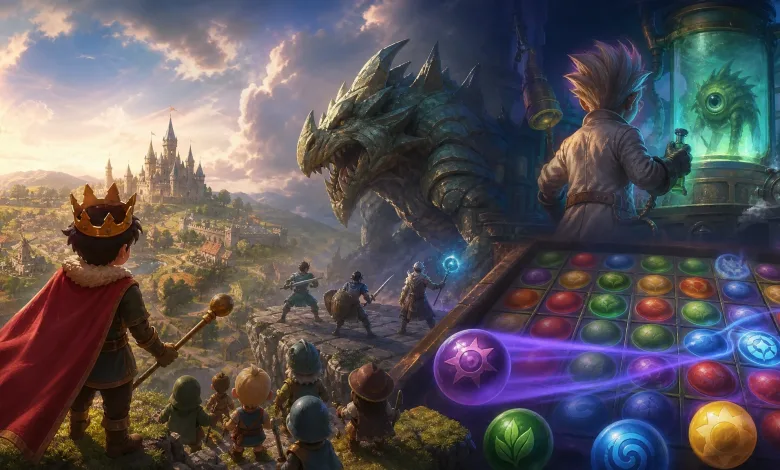
The Wii is often remembered for motion controls, party games, and family-friendly adventures, but its RPG library had far more range than its reputation suggests. While Nintendo’s console missed major seventh-generation RPGs such as Skyrim and Fallout 3, it still hosted games that took bold chances with combat, world design, multiplayer, and genre structure.
Some of these releases were strange experiments, while others found clever ways to make the Wii hardware part of the experience. Together, they show how much room there was for unusual RPG ideas on Nintendo’s motion-control console.
Puzzle boards and laboratories became RPG systems
Puzzle Quest: Challenge of the Warlords turned a Bejeweled-style match-puzzle system into the foundation for a full RPG. Battles used colored pieces, but the surrounding game included a world map, quests, equipment, spells, companions, character levels, and a lengthy campaign.
Almost every traditional RPG feature affected the puzzle battles. Leveling provided attribute points, while equipment, mounts, companions, and spells changed how encounters played out. The result was not a puzzle game with a few RPG decorations. It was a serious attempt to build an RPG around a completely different combat system.
Monster Lab took a different approach by making the player an apprentice mad scientist. Monsters were assembled from biological, alchemical, and mechanical parts, with construction minigames determining what kind of creature came out of the laboratory.
Those creations could then be used in battles, while missions, exploration, more minigames, and online matches provided reasons to keep building. The game’s systems all supported its central idea, so monster creation was tied directly to progression rather than being a side activity.
Little King’s Story blended real-time strategy, simulation, and RPG progression into a kingdom-management adventure. Players recruited citizens, assigned jobs, gathered resources, and led their subjects into combat as a young ruler responsible for a small kingdom.
Citizens served as the workforce, population, combat units, and progression system. Training them for specialized jobs unlocked new abilities and access to resources, while real-time commands made their role in battle just as important as their role in the kingdom. Few Wii games combined so many genres around one cohesive gameplay loop.
Parties and open worlds pushed the Wii’s scope
Marvel: Ultimate Alliance brought a large superhero party RPG to the Wii. Its roster included more than 20 heroes, each with individual power progression, while team compositions created additional bonuses during the campaign and dungeon-crawling sections.
The Wii version also adapted combat for motion controls. Directional attacks and motion-based powers gave the Wii release an identity beyond being a basic port. The game did not simply borrow Marvel characters for a short licensed adventure. It attempted to represent a broad superhero universe through teams, powers, and a sizeable campaign.
The Godfather: Blackhand Edition brought open-world crime action to the Wii with a control scheme built around the Wii Remote and Nunchuk. Punches, grabs, and gunplay were mapped to physical movements, giving the combat a more direct feel than the standard version.
The Wii edition also added more than 30 missions, including assassination and business assignments. Its ambition came from trying to reshape a multiplatform crime game around the Wii’s hardware instead of leaving it as a straight port.
Monster Hunter Tri made online play a central part of its Wii experience. Players could gather in an online city that worked as a persistent social hub, meet strangers, communicate, and organize hunts without relying on Nintendo’s Friend Code system.
Harder quest versions, additional monsters, and higher-level rewards gave the multiplayer mode its own progression path. That structure also created the beginnings of a multiplayer economy, something that was far from common on Nintendo hardware at the time.
Physical toys and board-game rivalry found a home
Skylanders: Spyro’s Adventure connected physical toys to an action-adventure RPG through the Portal of Power. Placing a figure on the device brought that character into the game, with statistics and progression stored on the toy itself.
Players could carry customized Skylanders between games while keeping their stats and gold. Figures could also unlock areas and items, turning the collection of 32 toys into part of the game’s design. More than 30 million Skylanders toys were sold worldwide, showing how powerful the toys-to-life concept became.
Dokapon Kingdom turned an RPG into a competitive board game. Players moved across a large board while fighting monsters, gaining classes and equipment, capturing towns, and building wealth. The board’s randomness and economic systems sat alongside familiar RPG progression.
The twist was that party members were also competitors. They could interfere with one another’s progress directly, turning a cooperative session into a contest where a close friend could become the biggest threat on the board. It was an unusual mix of multiplayer rivalry, RPG mechanics, and board-game rules.
Niche RPGs made the Wii feel less predictable
Baroque was already an uncompromising real-time roguelike when it first appeared on Sega Saturn and PlayStation. Its Wii remake kept the underlying game mostly intact, adding difficulty options without rebuilding the experience around motion controls or Wii hardware.
That made the release unusual for a different reason. The Wii was not widely associated with traditional RPGs, and Baroque was an especially niche choice for the system. Bringing its harsh dungeon-crawling design to a console dominated by very different RPG traditions was the remake’s main point of interest.
Shiren the Wanderer marked Chunsoft’s return to Nintendo home consoles in 2008. As part of the Mystery Dungeon series, it carried forward a punishing, unpredictable structure built around dangerous runs and the possibility of losing progress.
The series had already crossed over with franchises such as Final Fantasy, Dragon Quest, and Pokémon, but Shiren represented its core identity. No other Chunsoft Mystery Dungeon game followed it onto Nintendo’s home consoles, not even Shiren the Wanderer 4, leaving the Wii release as an unusual one-off in the franchise’s history.
These games did not follow one formula. Some rebuilt combat around puzzles, others made players manage kingdoms or custom monsters, and several used the Wii’s controls or online features in ways that standard ports never attempted. The result was a remarkably varied RPG lineup hiding beneath the console’s casual image.
Which of these Wii RPGs do you remember most fondly, and which one would you recommend to other players? Share your thoughts in the comments, then follow us on X, Bluesky, YouTube, Instagram, Steam, and Telegram.
Source: DualShockers
