Rust’s Printed and Polished Update Reworks Blueprints and Adds Gamepad Support
The overhaul also revisits livestock care, adds new wildlife, and targets memory use and server performance.

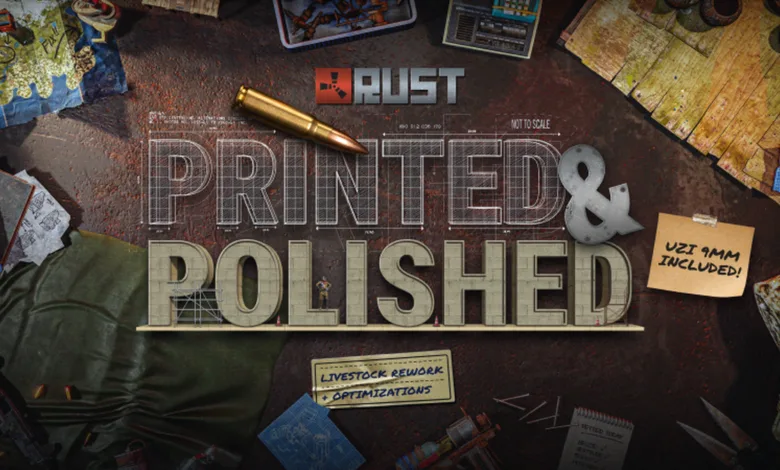
Rust’s Printed and Polished update changes how players advance through tech trees, adds gamepad controls through Steam Input, and reworks livestock care. The patch also brings an UZI 9MM, new wildlife, building adjustments, and a broad round of performance work.
Blueprint progression no longer spends scrap
Workbenches no longer need blueprint fragments to craft, and scrap has been removed from tech-tree progression. Instead, players use three blueprint currencies, fragments, pages, and books, corresponding to the three tech-tree tiers. Scrap still pays for research at a research table.


Basic blueprint fragments can now turn up in common loot such as barrels and boxes, then be upgraded into the next tier. Puzzle rooms and other harder content remain the quickest route through progression. Facepunch says the change is meant to ease the early-game bottleneck, while putting more weight on finding items, trading, and making allies.
Two workbench upgrades have changed along with the system. The salvage upgrade now has a 20% chance to preserve a blueprint when used, while the prototype upgrade has a flat 25% success rate and no longer doubles the cost.
Gamepad controls reach core gameplay
Controller support is now available across Rust’s core gameplay through Steam Input. Inventory and crafting use a stick-controlled cursor by default, but a new option switches those menus to D-pad navigation. The gamepad options screen also includes settings for adjusting how the controls feel. Facepunch says some features still lack dedicated controller support and will receive further work.
The new UZI 9MM Submachine Gun changes behavior with its stock position. Folded, it fires automatically and works with shields. Unfolded, it switches to semi-automatic fire and gains accuracy. Players hold the fire-mode button to switch between the two.
Livestock needs less babysitting
After Rust’s October update introduced farmable cows and sheep, the livestock system gets another pass aimed at reducing its daily upkeep. Buying a cow or feeding it at a trough establishes ownership, and players no longer need to stay nearby to keep that bond. Cows no longer die of old age, and starvation leaves them lying at 1 HP instead of killing them.
Troughs now show how long their food will support a group of cows. Cows can eat any food horses can, and plentiful grass means they visit the trough half as often. The interface displays ownership, pregnancy and fatherhood details, cooldowns, and production information. Cows can also store up to 3 milk at a time.
A new Potential stat records how happy an animal was as a young animal, then locks in when it reaches adulthood. Potential multiplies rewards, and only animals born in captivity can have it. Reproduction now depends on the herd and its space: free-range owned cows stop breeding once the herd exceeds 6, indoor cows need enough room, and unowned cows do not reproduce. Players can pet cows and sheep, and new shears gather more wool without harming a sheep if a swing misses.
New threats, food, and building options
A repaired lighthouse now opens the regular deep-sea cycle immediately. Multiple lighthouses share repair resources and progress, while maps without a lighthouse start with the cycle active. Crocodile Pie, including a richer version with twice the duration, scares away nearby animals such as wolves, bears, boars, sharks, and bees. Rams and bulls will not flee, but they will stop charging, which can help around a livestock pen.
Rare scientist-boat groups will patrol the seas around the mainland for up to an hour. They have no map markers or notifications and engage geared players under the same rules as the Patrol Helicopter. Their boats also get improved movement and targeting, scientists can take over driving if the driver is killed, and PT Boat turrets have a new shooting system.
Crows circle over corpses and scatter when explosions go off. Seagulls gather around coastal and water-based monuments, and resting birds startle when players approach. The Nailgun gets a new model, textures, and animations. Rust also adds mirrored L and U stairs, which players can flip with SHIFT + R while placing them or with a hammer within 10 minutes of placement.
Other practical adjustments include randomly spawned modular cars arriving with half their engine slots filled by low-quality parts. Those parts stay locked until the car first goes onto a car lift. Ramps should be easier to place and no longer conflict with roofs in the same way, while changes to building-skin collisions address placement problems and explosive splash damage passing through triangle frames. Berries now have a seed-extraction option, and map markers can be dragged with the middle mouse button.
Performance work targets clients and servers
Facepunch’s client staging data shows frame time reductions of 2.51 ms at 0.1% lows, 1.17 ms at 1% lows, and 0.54 ms at the median. The same data shows about 1.6 GB less memory use and garbage collection roughly every 12 minutes instead of every 6. These are developer staging figures, not independent benchmark results.
Some of the work tackles specific bottlenecks. In a large base, building-privilege checks fell from 5.7 ms to under 0.02 ms on both the client and server. Loading deep-sea content only when players travel there saves around 260 MB of RAM outside that area, and map generation is now almost twice as fast while keeping the same results.
Server restarts on the highest-population servers are expected to fall from 10 minutes to 2 minutes. Network batching cut traffic by 25% in a capture from a 500-player server, while the developer’s initial testing of network level of detail showed about 30% less position-update traffic.
Mac support and other announced changes
Starting with this patch, Rust no longer provides x86 builds for Intel-based Macs. Support going forward is limited to ARM64 and Apple Silicon. Facepunch also plans to block the older client map-loading method in December and points modders to the CL_LoadMap RPC instead. The older -useOldNavmesh startup option is due to be removed in the next patch.
Facepunch described Rust Premium as a future paid monthly service with exclusive in-game skins and non-gameplay perks, not a battle pass or gated reward track. It also said bans affecting more than 3,000 accounts tied to public and private scripting providers would roll out as the wipe began.
Which part of Printed and Polished would change your next Rust session most? For more on the blueprint overhaul and the changing livestock system, stay connected on X, Bluesky, YouTube, Instagram, Steam, and Telegram.
Rust
Developed by Facepunch Studios

Rust is a multiplayer survival game set on a procedurally generated island where players must manage hunger, thirst, and health while contending with hostile wildlife and other players. Starting with only a rock and torch, players gather resources, craft tools, weapons, and structures, and form or fight against clans in a persistent open world that resets on a regular wipe cycle. Originally developed as a clone of DayZ with Minecraft-style crafting elements, the game spent over four years in early access before its full release in 2018.
- Genre Shooter, Role-playing (RPG), Adventure, Indie
- Platforms PC (Microsoft Windows), Mac
- Perspective First person
- Modes Multiplayer, Co-operative, Massively Multiplayer Online (MMO)
- Release February 8, 2018
- Publisher Facepunch Studios
-
Age Rating