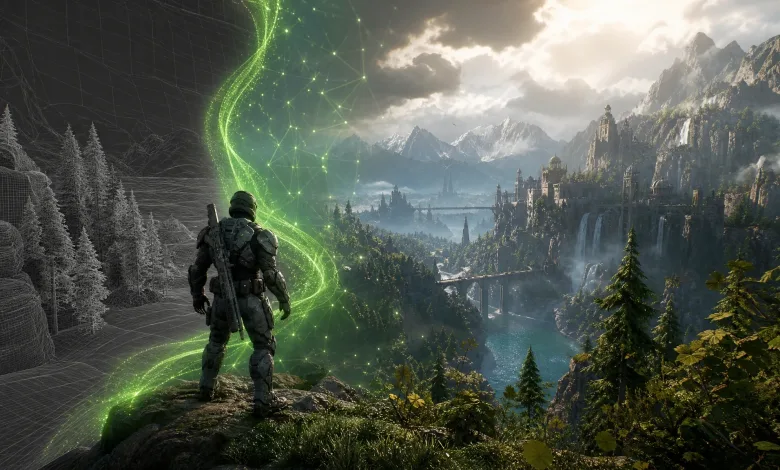
Nvidia used its SIGGRAPH 2026 keynote on Tuesday, July 21, to explain how developers will control DLSS 5 when the image-generation technology arrives in Fall 2026. The company presented the system as a way to add visual detail after a game has rendered its world, rather than as a replacement for traditional graphics.
DLSS 5 was revealed earlier in 2026 and quickly drew criticism over its use of AI-generated imagery. Nvidia’s latest presentation focused on the limits it plans to place around that generation, with developers deciding how much influence the model has from one frame to the next.

Edward Liu, Nvidia’s Director of Applied Deep Learning Research, explained that the game still creates the world according to its original art direction. DLSS 5 then works afterward to add to the appearance of that scene. The company described the result as a new level of realism while rejecting the idea that AI would replace the graphics pipeline.
Unrestricted generation would not work well for real-time rendering because the model could produce a different result in each frame. That would make it impossible to guarantee what the player sees next. Nvidia said DLSS 5 must instead use a more controlled process that maintains consistency during playback.
The presentation identified three central technical challenges: preserving artistic intent, streaming results frame by frame, and producing them in real-time 4K. Developers will have tools to fine-tune the intensity of the generation on a per-frame basis, with control over effects such as subsurface scattering, reflections, and lighting.
That approach gives studios a way to decide where DLSS 5 contributes to a scene and how strongly it appears. Nvidia compared the technology’s role to the way programmable shaders and ray tracing extended existing graphics techniques, though DLSS 5 uses learned image generation as its final stage.
DLSS 5 is scheduled to ship in Fall 2026. Nvidia has not provided a more specific release date in the presentation details available here.
DLSS 5 still has plenty to prove once players can see it running in actual games. Share your thoughts in the comments, and follow us on X, Bluesky, YouTube, and Instagram.