An unofficial Nvidia DLSS 5 runtime is already being pushed into PC games, and the first results look less like a clean image upgrade and more like a face filter that escaped from the lab. Modders have made the experimental build run in Grand Theft Auto V, Control, Cyberpunk 2077, and several PC games that also have PS5 releases, with character models, lighting, and other visual details taking most of the damage.
Earlier DLSS versions generally use machine learning to rebuild a higher-resolution image from a lower-resolution input while staying close to the original artwork. DLSS 5 goes further by using AI image generation to alter the image itself. That can mean extra texture and facial volume, but it can also impose a synthetic look that clashes with a game’s original art direction.


DLSS 5 has not been officially released. The relevant file, nvngx_dlssnr.dll, surfaced in an NBA 2K27 early access build, where it did not provide direct controls. Windows lists it as Nvidia DLSSNR version 310.8.0.0, a detail also reported by VideoCardz. RenoDX community modders have since been injecting the library into other games through an experimental runtime, including Steam releases of PC games also available on PS5.
Because the current build is being tried in games that were not necessarily prepared for it, results can swing wildly from one character to the next. One face may gain convincing detail while another suddenly looks much older or more artificial. Grace Ashcroft from Resident Evil Requiem offered an early example of the problem, with fans objecting to an overly beautified appearance after the filter altered her face.
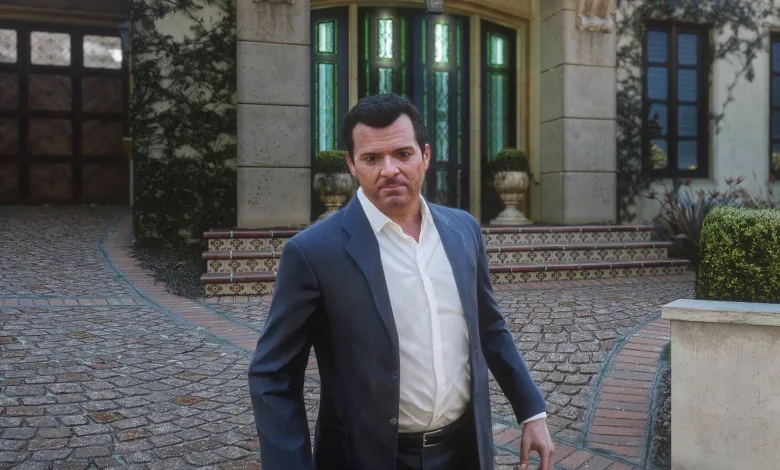
Grand Theft Auto V is the clearest example so far. Michael’s character model receives a facial makeover that looks unnaturally polished and just a little wrong. It is the kind of visual change that makes a graphics demo feel like a cursed character creator.
LMAOOO I Yassified michael pic.twitter.com/9rfalErej5
— SwurvGaming (@SwurvGaming) August 28, 2026
Control pushes the experiment even further. The runtime’s panel includes 7 overlay styles, although the test reported that only 3 currently worked. Style 1, pushed to its maximum setting, changes Jesse Faden’s facial features so sharply that she can look like an entirely different character. The same test reported that Ray Reconstruction would not work, while Neural Reconstruction did. Its comparison used ultra settings, ray tracing enabled, and 2 rays.
So DLSS 5 on control, for some reason i can't get RR to work, but NR works fine. It seems only 3 styles work right now. Heres a side by side of style 1 cranked up to the max vs vanilla. these are ultra settings rt on with 2 rays. pic.twitter.com/8hC4WBkImk
— SwurvGaming (@SwurvGaming) August 28, 2026
Hogwarts Legacy shows why stylized or game-specific character models may be an awkward match for the current experiment. A student can receive heavier skin texture, clearer separation between the cheeks and jaw, and a more mature appearance. At stronger settings, otherwise neutral expressions can become noticeably severe, turning extra detail into another kind of face filter.
Starfield provides a less unsettling example. With the settings adjusted carefully, a character with flat, untextured skin can gain more human-looking detail and facial volume. The result still changes the original artwork, but the added detail can read as an improvement rather than an unwanted filter.
More familiar faces are getting the AI treatment
Unofficial tests on Steam versions of several games with PS5 releases show that the uncanny effect is not limited to older PC titles. In Marvel’s Spider-Man 2, MJ remains recognizable, but DLSS 5 gives her brighter red lips and darker eyes, changing the character’s established look instead of simply adding detail to the existing model.
Side by side comparison of the New DLSS 5 in Marvel's Spider-Man 2 pic.twitter.com/BBS5KTVW1I
— dvesf (@dvesf_yt) August 28, 2026
The Last of Us Part 2 demonstrates a different problem. Ellie looks much older than intended, while the lighting around her no longer matches the surrounding scene. The pass is therefore changing more than facial geometry; it can also make a character look as though she belongs to a different lighting setup.
The Last of Us Part 2 comparison
Before & After DLSS 5 pic.twitter.com/wT85CRNcW2— dvesf (@dvesf_yt) August 28, 2026
Final Fantasy 7 Rebirth provides the most exaggerated example so far. DLSS 5 pushes Cloud’s face into an unusual look that borders on parody, prompting a strong reaction from viewers.
I AM SCREAMING LMAOOOOOO https://t.co/N1KYcRemdi pic.twitter.com/1l5NSHaO2J
— Jordan Starkweather 🔜 PAX West (@jackal27) August 28, 2026
Early reactions are split along those lines. Some testers have been pleased with more convincing skin and facial structure, while others see the same changes as a loss of the game’s visual identity. For now, the best results seem to depend heavily on the character, the game, and how aggressively the settings are pushed.
Nvidia still defends DLSS 5
Nvidia CEO Jensen Huang has pushed back against the criticism, arguing that DLSS 5 preserves artistic control. He has described the system as a form of content-control generative AI, which Nvidia calls neural rendering.
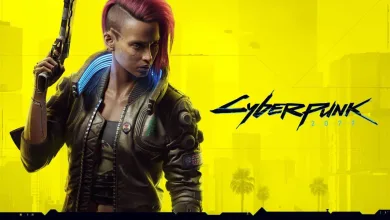
The experimental effects have also been shown in Cyberpunk 2077, but the project is still rough around the edges. RenoDX has not released a public version of the mod, and the current build has trouble running alongside Ray Reconstruction and HDR.
The problems are not limited to character faces. The AI pass runs after upscaling and other rendering steps, adding more work to the graphics pipeline. Even an Nvidia GeForce RTX 5070 Ti could struggle with the current build, so this is not a lightweight filter for older PCs.
None of this should be confused with a finished Nvidia feature. DLSS 5 remains unreleased, and this community test may look and behave differently before the reported fall release. For now, it is a strange technical experiment with the unfortunate habit of turning recognizable characters into uncanny mannequins.
Would you want to see Nvidia’s finished version after this early look, or should Michael be left alone? Share your thoughts in the comments, and follow us on X, Bluesky, YouTube, Instagram, Steam, and Telegram.