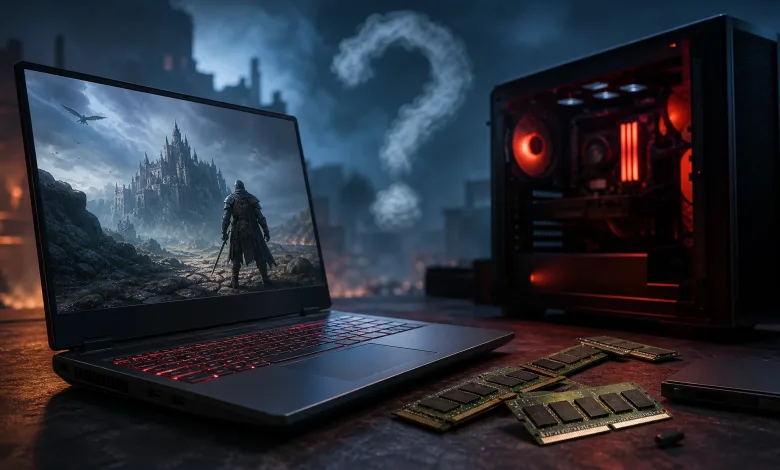
Microsoft quietly removed its recommendation for 32GB of RAM in high-end gaming PCs, just as laptops with only 8GB of memory are beginning to appear on store shelves again. The documentation change does not mean 8GB is suddenly enough for modern PC gaming, but it does make the timing look rather awkward.
Windows Latest first noticed the change. Microsoft previously used its gaming PC setup guidance to promote higher-memory configurations, but the old page now leads to a general help page instead. An archived version of the guidance still shows what the page looked like before, while the current Microsoft page no longer contains that advice.


The edit follows Microsoft’s announcement earlier in 2026 that it planned to release a Surface Laptop with 8GB of RAM. That machine is not aimed at replacing a gaming desktop, but it arrives alongside a wider return to low-memory configurations. Older gaming laptops with 8GB are also appearing at retailers such as Newegg and Best Buy.
8GB gaming laptops are still asking for too much money
Best Buy had more than 40 gaming laptops with 8GB of RAM available on August 7, with mainstream models ranging from $745 to $1,249.99. Paying four figures for a machine that may struggle before a demanding game even starts is a rough deal.
One HP Victus configuration with an RTX 4050 and 16GB of memory was available for $939 at Best Buy. That comparison says plenty. A 16GB system can cost more than an entry-level 8GB laptop, but it gives games far more room to work without immediately forcing major compromises.
Memory prices have been climbing alongside broader supply problems, and that pressure is reaching laptops as manufacturers try to keep entry-level prices down. Models such as the HP Victus, MSI Thin A15, and Asus TUF range are among the machines appearing with smaller memory capacities.
16GB remains the sensible starting point
Windows uses part of a system’s RAM before a game launches, leaving less available for the game itself. Many recent releases already target 16GB for smooth play, and some can become difficult to run when a system has only 8GB.
That makes 16GB the sensible minimum for a new gaming laptop. 32GB is still the better target for anyone playing large strategy games, running extensive mod collections, or keeping several demanding applications open at the same time. It is not required for every game, but it gives a higher-end laptop more breathing room than Microsoft’s revised documentation now suggests.
When the budget is tight, RAM should be one of the last places to cut. Lower graphics settings, a smaller SSD, an older CPU generation, or a less powerful GPU are all easier compromises than trying to game on 8GB. A laptop that runs at 1080p with reduced visual settings is still more useful than one that cannot keep a modern game running smoothly.
Microsoft’s page removal does not change the memory needs of PC games. Shoppers should check the specifications carefully, especially when a sale price makes an 8GB laptop look tempting. At minimum, aim for 16GB, and consider 32GB if the laptop is meant to last several years.
Tell us what you think about Microsoft’s RAM advice in the comments, and follow us on X, Bluesky, YouTube, Instagram, Steam, and Telegram.