Riot Penalizes 296,416 Accounts for Rank Manipulation in VALORANT and League of Legends
Riot also said MFA and TPM 2.0 requirements are being accelerated, though it did not provide dates for mandatory changes.

Riot Games has banned or suspended 296,416 accounts across VALORANT and League of Legends for rank manipulation since late 2025. The total comes from Vanguard’s Anti-Boost system, which detects boosting, purchased ranks, and players who benefit by queuing alongside someone else’s boosted account.
PSA: Boosting, smurfing, hitchhiking… it’s all cheating.


Vanguard’s boosting detection expanded from @LeagueOfLegends to @VALORANT earlier this summer and bans have been rolling out ever since. 296,416 rent-a-rank customers served and counting. pic.twitter.com/QlLqsi6b9q
— Riot Games (@riotgames) September 17, 2026
Riot also said it is accelerating multi-factor authentication and TPM 2.0 requirements as part of a broader effort to make account sharing and disposable setups harder to use. Mandatory dates for either change have not been announced.
How Vanguard identifies rank manipulation
Anti-Boost looks for unusual rank gains tied to another player’s performance or account access. A higher-skilled player who logs into someone else’s account to raise its rank is treated as a booster, while the account receiving the unearned progress is the boostee. A hitchhiker queues with a booster or boosted account to benefit from the inflated rank.
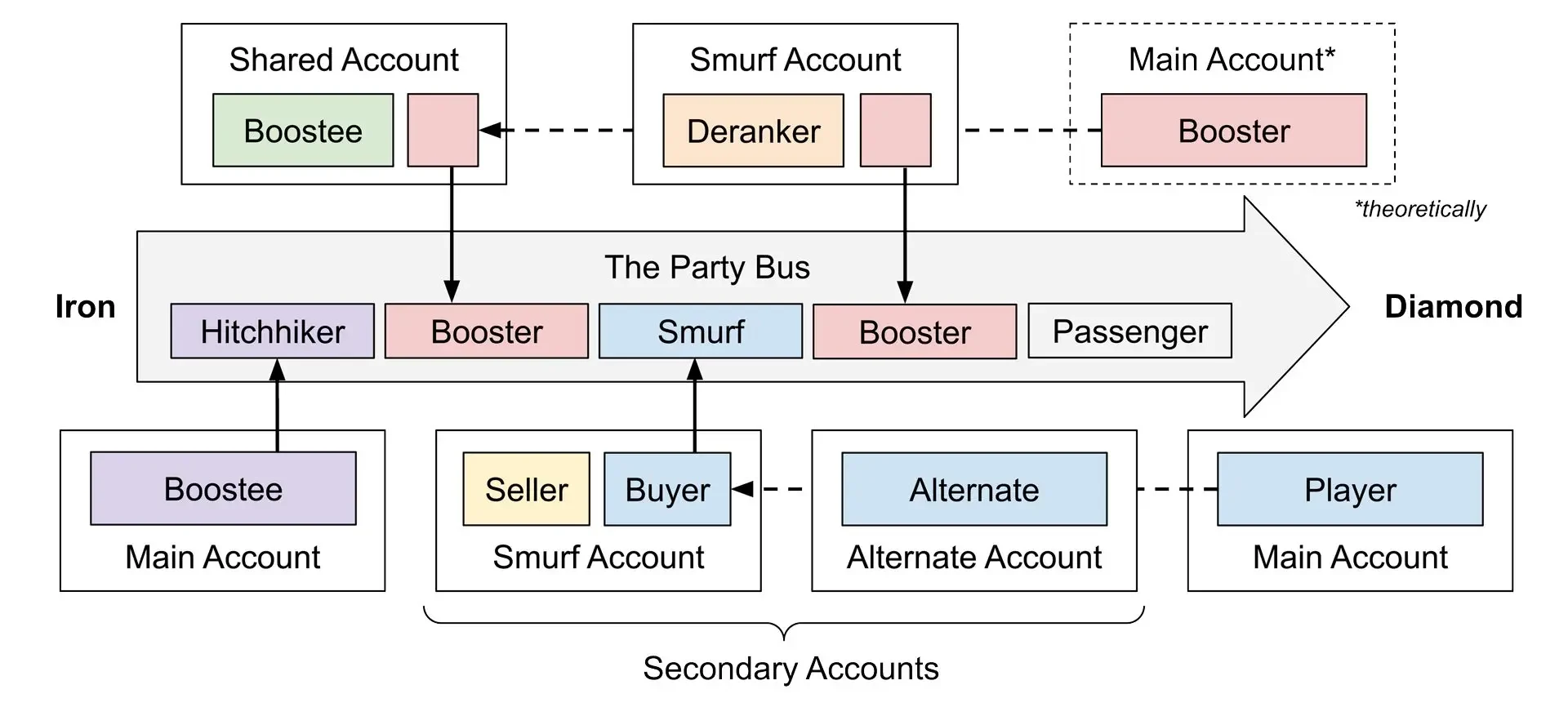
Riot separately identifies purchased or botted accounts with no legitimate original owner as smurf accounts. A self-created alternate account is not automatically a violation. Players can maintain an alt if they created, leveled, and play it themselves without sharing access or using it to carry another player.
Rank and rewards can be taken back
Penalties depend on the account’s role and history. Boosted accounts can lose ranked points or rewards and receive suspensions that become longer after repeat offenses. Purchased or illegitimate smurf accounts can be banned outright, while repeat boosters can also see penalties applied to their main accounts.
Hitchhikers can lose the rank they gained by queuing with a booster or smurf, even if they say they did not know what was happening. Riot’s approach treats the competitive benefit itself as the problem, not only the account that changed hands.
VALORANT now uses the League enforcement model
Riot says Anti-Boost began on League of Legends in September 2025 before expanding to VALORANT earlier in summer 2026. The company laid out its terminology and enforcement approach in its July 2026 Playing Fair post.
VALORANT had already received rank-manipulation penalties through Patch 13.01, including possible account suspensions, rank reversions, and ranked reward reversions. The new total shows that Riot’s detection work is now operating across both games rather than relying only on player reports.
MFA and TPM 2.0 checks are moving closer
Riot is also tightening account and hardware verification. The company said MFA restrictions are being moved up after a Riot Mobile beta found that 80 to 90 percent of stolen accounts had MFA disabled. TPM 2.0 and Vanguard hardware attestation are intended to help verify that players are using their own physical hardware instead of easily replaced or shared setups.
Players can already opt into Vanguard Pre-Check ahead of any mandatory rollout. Riot has not given a date for when MFA or TPM 2.0 requirements will become compulsory, but both are part of the studio’s effort to limit rank manipulation before it reaches ranked matches.
Would stronger MFA rules make you more comfortable with ranked play, or should Riot focus first on detecting the players who profit from boosting? Share your view, and follow us on X, Bluesky, YouTube, Instagram, Steam, and Telegram.