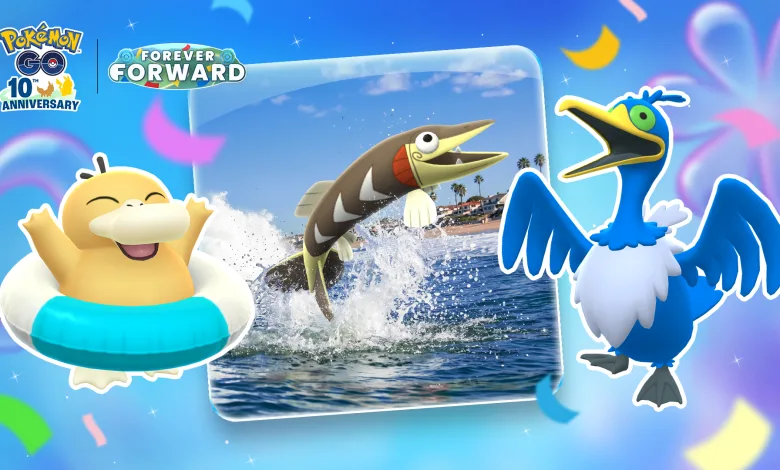
Cramorant is coming to Pokémon GO as one of the featured Pokémon for Water Festival 2026, and its early PvP numbers already give Trainers a reason to pay attention. The Flying/Water type looks much more promising in Great League than its goofy bird design might suggest.
Ultra Unlock: Water Festival 2026 will run from August 18 at 10:00 a.m. local time through August 24 at 8:00 p.m. Cramorant will appear through Eggs, GO Pass rewards, and GO Battle League rewards at Rank 16 or higher. It will not have a Shiny form during the event.
Ultra League is a different story. Cramorant cannot reach 2,500 CP, and its projected results there do not justify building one for that format. Great League is where the action is.
Why Cramorant fits Great League
At the recommended Great League spread, Cramorant averages 121 Attack, 121 Defense, and 126 HP. The highest-stat-product option is listed as 0-14-11 at Level 27 and 1,500 CP, giving it a sturdy profile for a Pokémon that is also bringing useful Flying damage.
Among the other Flying/Water choices, Cramorant has more bulk and better overall PvP stats than Pelipper, Swanna, and Gyarados, with only Mantine coming out ahead in that area. That is a surprisingly strong starting point.
Its fast move is another big reason to take it seriously. Peck deals 3.0 damage per turn and generates 4.0 energy per turn, while also receiving Same Type Attack Bonus from Cramorant’s Flying typing. Mantine and Pelipper rely on Wing Attack for the same energy generation, but Wing Attack deals 0.5 less damage per turn. Gyarados’ Dragon Breath matches Peck’s raw damage and energy figures, yet it does not receive Flying-type STAB.
That puts Cramorant in a fun spot beside established choices such as Mantine, Pelipper, and Swanna. The family resemblance is there, but Cramorant has a different rhythm.
Cramorant’s charge moves create the real debate
Cramorant’s available charge attacks cover four different jobs:
| Move | Type | Damage | Energy |
|---|---|---|---|
| Dive | Water | 50 | 40 |
| Surf | Water | 75 | 45 |
| Fly | Flying | 80 | 45 |
| Hydro Pump | Water | 130 | 75 |
Dive reaches the lowest energy cost, but 50 damage is a tough sell when the move does not add a debuff. It hits with the same raw damage as moves such as Brick Break and Spirit Shackle, though it lacks their extra effects. Surf costs only five more energy and deals 25 additional damage, but that 45-energy price makes it slower than the cheap charge options used by Cramorant’s rivals.
Pelipper’s Weather Ball costs 35 energy for 60 damage, while Gyarados’ Aqua Tail costs 35 energy for 55 damage. Mantine’s Twister and Swanna’s Aqua Jet both cost 40 energy for 70 damage. Cramorant’s Dive is cheaper than Surf, but its damage output is the tradeoff.
The likely answer is a Dive/Fly moveset. Each Peck generates eight energy, so five fast moves reach Dive’s 40-energy requirement. Fly needs six Pecks, and using two 45-energy moves back-to-back still leaves Cramorant short of the second attack after the first one. Dive keeps the pressure moving, while Fly serves as the heavier finisher.
There is one major unknown. Dive or Surf are supposed to trigger Cramorant’s form changes, sending it into either Gulping Form while it chomps on an Arrokuda or Gorging Form while trying to swallow a Pikachu. Those forms may provide a one-time stat reduction: Gulping Form reportedly lowers the opponent’s Defense by one stage, while Gorging Form may reduce Attack by two stages. Until the mechanic is confirmed in play, the numbers below treat Cramorant as if those form changes do not exist.
Great League results put Cramorant beside the top Flying Waters
In the Great League 1-1 simulation, Dive/Fly Cramorant beats Dewgong and Shadow Sableye, two opponents that both Mantine and Pelipper struggle to handle. Its Flying-focused damage also lets it beat Altaria, Feraligatr, and Azumarill in matchups where Pelipper or Mantine falls short.
Cramorant also gains wins over Florges, Thievul, Togekiss, Galarian Weezing, and Jumpluff compared with Mantine’s usual matchup spread. The tradeoff is a group of losses to Clodsire, Empoleon, Fearow, Grumpig, Guzzlord, and Galarian Stunfisk. Pelipper remains better against several of those targets, including Galarian Stunfisk, Fearow, Guzzlord, Furret, Thievul, Wigglytuff, and Tinkaton.
A top-ranked IV spread improves the picture even more, adding Fearow and Jellicent to Cramorant’s wins in the rank-one IV simulation. It is a theoretical result for now, but it gives Trainers a clear target when checking Cramorant’s appraisal screen.
With two shields per side, Cramorant’s 2-2 results edge past both Mantine and Pelipper, even before the possible form-change debuffs are counted. It picks up wins over Galarian Corsola, Furret, Feraligatr, Azumarill, Florges, Grumpig, Seaking, Wigglytuff, Galarian Weezing, and Galarian Stunfisk that Mantine misses. It also handles Empoleon and Togekiss better than Pelipper.
Mantine still has the better matchup against Jellicent, Kingdra, Tinkaton, Malamar, Fearow, and Clodsire. Pelipper counters with wins over Altaria, Corviknight, Mimikyu, Fearow, and Clodsire. Cramorant is not replacing them outright, but it has enough different wins to earn its own team slot.
Shields-down battles are less kind. In the 0-0 simulation, Cramorant is the only one of the three that beats Dewgong and Mantine. However, it loses to Clodsire, Kingdra, Malamar, Galarian Stunfisk, Togekiss, and Galarian Weezing, all of which both rivals can defeat. Grumpig and Guzzlord also favor Mantine, while Azumarill and Jumpluff favor Pelipper. Swapping Dive for Surf does not repair the no-shield matchup, so the form-change mechanic could be the key to Cramorant’s ceiling.
Barraskewda is a much lower PvP priority
Water Festival 2026 also brings Barraskewda, but it does not share Cramorant’s sturdy profile. Barraskewda is among the frailest Water types in Great League; only Sharpedo is slightly less durable. Even with a good moveset, the Great League results are poor, and the Ultra League results do not give it a meaningful role either.
Barraskewda is worth catching for the collection, but Cramorant should receive the better investment of Stardust, Candy, and trading effort. If the new form mechanics work as suggested, Cramorant could become even more useful after its arrival.
Cramorant is the Water Festival target
Cramorant already competes with the strongest Flying/Water options in Great League without relying on its unconfirmed form changes. Its wins and losses differ from Mantine and Pelipper rather than simply copying them, which is exactly what a new meta pick needs.
Trainers should prioritize finding a strong Great League Cramorant, especially one close to the 0-14-11 spread. Barraskewda can wait in the storage box for now.
Share your thoughts in the comments, and follow us on X, Bluesky, YouTube, Instagram, Steam, and Telegram.
Pokémon Go
Developed by Niantic Labs, The Pokémon Company
Pokémon Go is an augmented reality mobile game that uses GPS to let players locate, capture, train, and battle Pokémon in real-world locations. Players explore their physical surroundings to find PokéStops for items, battle at Gyms for team control, participate in Raid Battles cooperatively, and compete in the Go Battle League's player-versus-player format. The game is free-to-play with in-app purchases and features Pokémon from across multiple generations of the franchise.
- Genre Role-playing (RPG), Simulator
- Platforms Android, iOS
- Perspective Third person, Bird view / Isometric, Side view
- Modes Single player, Massively Multiplayer Online (MMO)
- Release July 6, 2016
- Publisher Niantic Labs
-
Age Rating