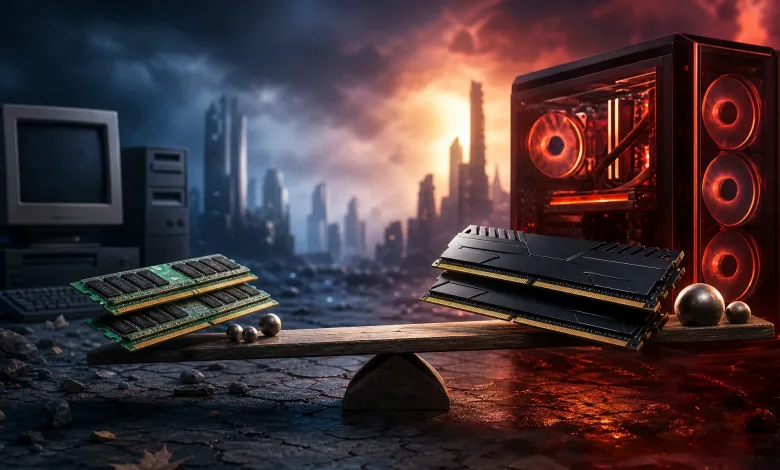
The current memory shortage has created a strange situation for PC builders: RAM costs less per gigabyte than it did in 2007, but buying enough memory for a high-end gaming PC now requires a much larger budget.
Scientist and software performance expert Daniel Lemire described the reversal in a post on X: “On a historical basis, computer memory has been falling at an exponential rate for decades. But we just undid about 20 years of progress. RAM on a per unit basis is about as expensive as it was in 2007.”

On a historical basis, computer memory has been falling at an exponential rate for decades. But we just undid about 20 years of progress.
RAM on a per unit basis is about as expensive as it was in 2007.
To my knowledge, it is an historical anomaly. I cannot recall a similar… pic.twitter.com/UH6LgZ1fc4
— Daniel Lemire (@lemire) August 5, 2026
Price-per-gigabyte charts support only part of that argument. They show how much more capacity shoppers receive for each dollar, but they do not fully capture the cost of buying a useful amount of memory for a gaming PC. A kit-by-kit comparison from 2007 through 2026 makes the difference easier to see.
What 2007 DDR2 kits cost
In 2007, 4 GB was near the upper end of common desktop memory capacity. The period example was a 4 GB kit made up of 2x 2 GB DDR2-800 modules, believed to be TeamGroup Xtreem memory. Many PC owners were still using 2 GB, usually as 2x 1 GB DDR2, which was enough for 32-bit Windows systems.
Contemporary AnandTech deal discussions put a good 4 GB kit at about $100. A separate 2 GB DDR2-800 deal was priced around $60, or $45 after a rebate.
| Period | Memory kit | Approximate price | Approximate price per GB |
|---|---|---|---|
| 2007 | 4 GB DDR2-800 | $100 | $25 |
| 2007 | 2 GB DDR2-800 | $60, or $45 after rebate | $30, or $22.50 after rebate |
| 2026 | 16 GB DDR5-6000 | About $250 | About $15–$16 |
| 2026 | 32 GB DDR5-6000 | About $500 | About $15–$16 |
DDR5 is cheaper per gigabyte, but the checkout total hurts
Reasonably specced DDR5-6000 kits were priced at about $15–$16 per GB in the 2026 comparison. A 32 GB kit listing was around $500, while 16 GB DDR5-6000 options came in around $250.
On the narrow price-per-GB measure, today’s memory is still cheaper than the 2007 examples. The older 4 GB kit worked out to roughly $25 per gigabyte, and the more common 2 GB kits were closer to $30 per gigabyte. That is why Lemire’s statement needs some context: the amount of memory available for each dollar continued to improve, even as the total price of a suitable upgrade climbed.
For gamers, the more useful comparison is how much memory the whole system needs. In 2007, 2 GB or 4 GB could serve as a reasonable target. In 2026, the comparable choices are 16 GB and 32 GB, with 32 GB being the more comfortable option for a high-end gaming PC.
Before the current shortage, PCPartPicker’s price history showed 32 GB of fast DDR5 selling for roughly $100–$150. That meant buyers could get eight times the capacity of a 4 GB 2007 kit for about the same nominal price. The jump to roughly $500 reverses much of that progress at the point of purchase.
Inflation does not erase the gap. Using an inflation calculator, the $65–$100 spent on a decent amount of RAM in 2007 would be about $100–$160 today. A $500 32 GB kit is still roughly four times that range, depending on which older price serves as the comparison.
That leaves two truths sitting next to each other. RAM is cheaper when measured by the gigabyte, but the cost of equipping a gaming PC with a useful amount of it has risen sharply. The memory shortage has turned what used to be a routine upgrade into one of the most painful parts of a new PC build.
The pressure is showing up elsewhere in the PC market too. Microsoft recently removed a 32GB gaming-PC recommendation while 8GB gaming laptops began returning to store shelves, a development detailed in Microsoft’s RAM advice change.
How has the memory shortage changed your upgrade plans? Share your thoughts in the comments, and follow us on X, Bluesky, YouTube, Instagram, Steam, and Telegram.