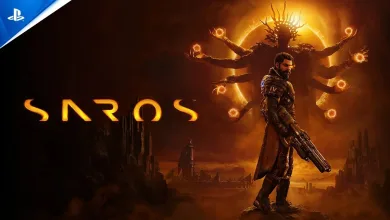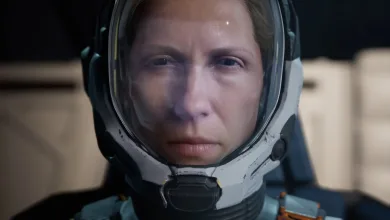
Housemarque used its June 17 breakdown to show how Saros pushed its visual effects stack from a long-running particle engine into a broader system called Graphite. The technical tour was led by Housemarque Graphics Architect Sharman Jagadeesan, Senior Graphics Programmer Konsta Toivanen, and VFX Architect Risto Jankkila, each taking a different piece of the work from fog to spawn effects.
NGP, short for Next-Gen Particles, started as a prototype for Resogun in 2013 and grew across every Housemarque game that followed. By the time Saros came along, the system was mature, but it was also carrying a decade-plus of game-specific decisions. Graphite absorbed that older tech and folded GPU simulation, rendering, tooling, and DCC integration into one architecture built for PlayStation hardware.

That matters because Housemarque’s visual identity depends on effects that stay readable in motion while still feeling alive. Graphite gives the studio room to keep that look without treating each game like a fresh start.
Fog that reacts to the fight
The biggest focus here is volumetric fog. Housemarque split it into two layers: low-frequency fog for ambient atmosphere and high-frequency fog for character-driven effects in special story rooms on Carcosa.
The low-frequency side began with Unreal Engine’s froxel fog, but Housemarque rebuilt major parts of it. The team lowered the hysteresis coefficient from 90% to 50%, then used blue noise jitter and depth clamping to keep the fog stable on fast-moving cameras and lights. It also added a dual Henyey-Greenstein phase function, a coloured absorption coefficient, a self-shadowing system, and a physically based sky lighting integral.
That fog is also interactive. Advection from the player-following fluid simulation feeds into the density step, so movement, projectiles, explosions, and enemies all leave a real-time mark in the scene.
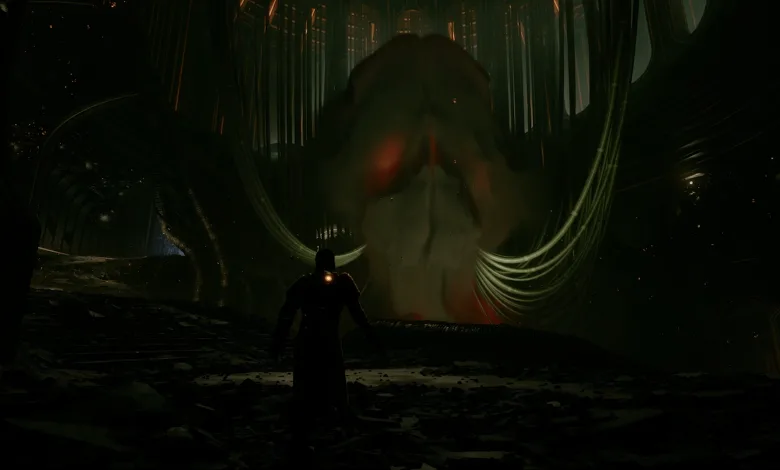
For the high-frequency side, Housemarque built a custom ray marcher that clusters scatter data into 8x8x8 voxel groups before marching. Empty regions get skipped, which helps the effect hold detail without wasting work. The studio also evaluates a light volume per scatter volume and exposes albedo, absorbance, density, and shadowing so artists can tune the result for each effect.
The two systems then feed into one another. Housemarque samples the low-frequency fog during the high-frequency march and pushes the results back so both layers stay in sync.
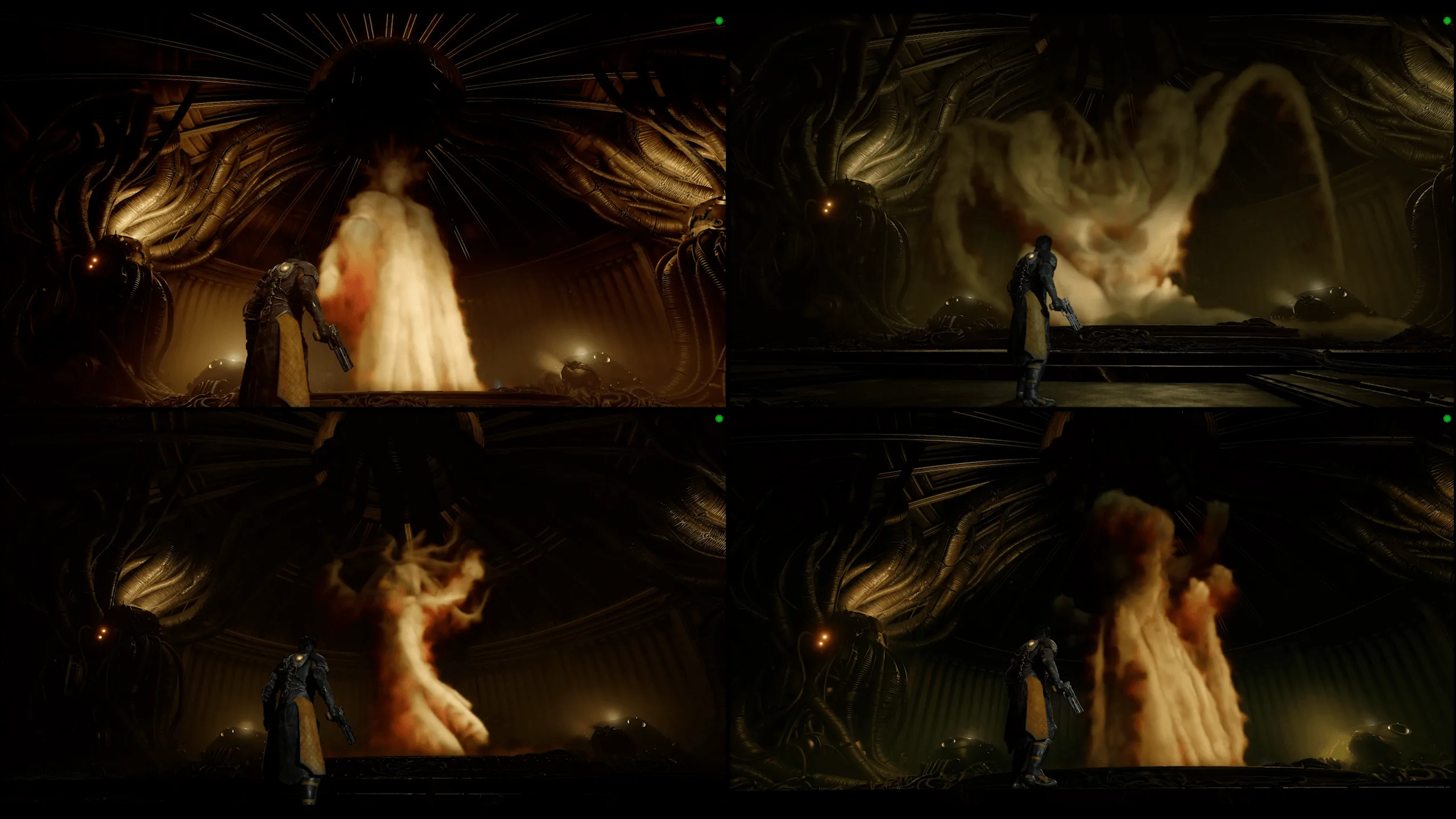
One use case is the Prologue’s smoky skull with cables attached to it. Another is the mirage work in four biomes, where Arjun faces smoke creatures inside narrative rooms. Housemarque also used its real-time skeletal mesh voxelizer to pull existing meshes into those rotating mirage scenes.
Houdini feeding Graphite
Housemarque also wanted a better way for artists to author volumetric effects. Before Graphite, the studio relied on per-voxel expressions for density and emission, plus fluid sims for advection. That worked, but anything more complex could get expensive at runtime.
Graphite changed that with two new tools. The Offline Houdini Data Pipeline lets artists bake complex data in Houdini before it ever reaches the game. The Runtime Point Cloud Rasterizer turns simulated points into a volume in real time.
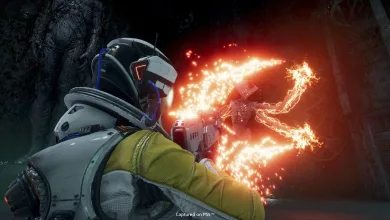
That workflow shows up in the player spawn sequence. Housemarque builds splines directly onto the player’s skeletal mesh in Houdini, exports control points as particles, and then lets Graphite decide how those pieces move in game. At first the splines drift freely, then they guide back toward the character as the runtime system takes over.
Marching Cubes gives the sequence its shifting, solid-surface look. Housemarque also emits volumetric fog from the splines to create rising steam or smoke, then adds spark particles that collide with the player through an SDF based on the character’s collision capsules. The player attracts those particles at a distance, but repels them once they get too close, which helps sell the feeling of reforming from something hot and unstable.
The full effect runs at 60 fps on base PS5 with no baked simulation assets. Housemarque said that lets the team ship multiple spawn animations with slight randomization, so each wake-up can feel different without breaking the runtime setup.
Saros is still a showcase for Housemarque’s effects work, but this breakdown makes the bigger point plain: Graphite is now the studio’s way of keeping its visuals reactive, fast, and tied to gameplay instead of locked to a single pipeline.
Have thoughts on Housemarque’s approach to VFX in Saros? Share them in the comments, and follow us on X, Bluesky, YouTube, Instagram.
Source: PlayStation Blog