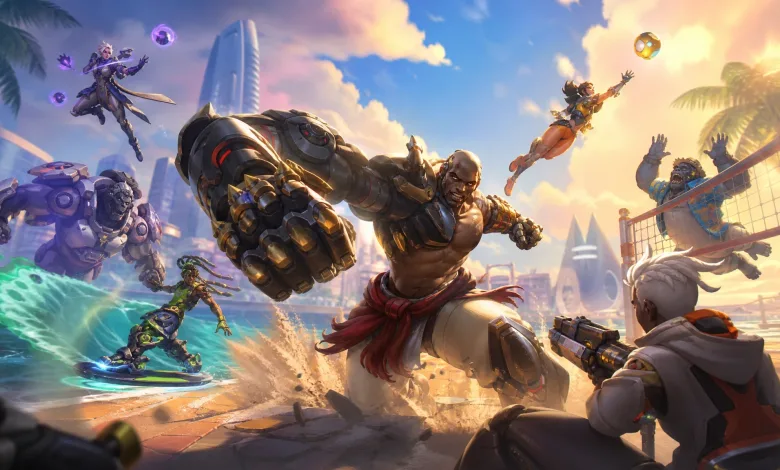
Overwatch 2 is trying another way to bridge its 5v5 and 6v6 formats, but the latest experiment may be creating the exact imbalance it was meant to avoid. The limited-time Quickplay Hacked event now includes a 1-3-2 flex setup, and early matches suggest that teams with two tanks can overpower teams that stick with one.
Quickplay Hacked serves as a testing ground for Team 4, giving players temporary rulesets while the developer gathers feedback. This version keeps six players on each team, with one tank, three damage heroes, and two supports. The twist is that one of the damage players can switch into the tank role during a match.


The idea is easy to understand. A single required tank could preserve the shorter queue times associated with 5v5, while the extra player would bring back some of the crowding and team interplay that define 6v6. On paper, it sounds like a tidy middle ground.
In practice, the format gives teams a strong reason to run two tanks whenever possible. Tanks in this mode are tuned with 6v6-style team balance in mind, including reduced health and adjusted abilities. Zarya, for example, has one bubble instead of two. Those changes may work when two tanks share the pressure, but they leave a lone tank at a serious disadvantage.
The matchup can become lopsided quickly. A team running two tanks has more room to absorb mistakes, protect its backline, and cover an ally who gets caught out. A solo tank has fewer ways to respond when the opposing pair works together. If one enemy tank makes a mistake, the second can often cover it before the other team can take advantage.
That makes the flexible damage slot feel less like a genuine choice and more like a queue-time shortcut. Players can technically choose between 1-3-2 and 2-2-2, but the latter composition has a built-in advantage whenever both teams are similarly skilled.
5v5 and 6v6 Still Serve Different Purposes
The experiment also highlights why combining the two formats has been so difficult. Six-player teams create busier fights with more overlapping abilities and room for coordinated tank play. Five-player teams give each player more space to influence an engagement, while individual mistakes are easier to punish.
Both formats can work for different reasons, but the 1-3-2 ruleset seems to inherit the weaknesses of each. It has the player count of 6v6 without properly supporting a solo tank, while its optional second tank makes the match feel less like the 5v5 structure it is trying to preserve.
For now, the mode is best viewed as a test rather than a final answer to the long-running 5v5 versus 6v6 argument. Blizzard can still adjust the health values, abilities, or role rules based on player feedback. The current version, however, makes the choice look fairly simple: teams that can field two tanks have little reason not to do so.
Overwatch 2 may be better served by treating 5v5 as its main format and keeping full 6v6 as a separate option, rather than asking one ruleset to satisfy both audiences. Share your thoughts on the 1-3-2 experiment in the comments, and follow us on X, Bluesky, YouTube, and Instagram.
Overwatch
Developed by Blizzard Entertainment

Overwatch is a free-to-play first-person hero shooter developed by Blizzard Entertainment. Players choose from a large roster of role-based heroes and compete in 5v5 team matches across various objective-based game modes, with both casual and ranked competitive play. Originally released as Overwatch 2 in 2023 as a successor to the 2016 original, the game was rebranded to simply Overwatch in 2026 with a renewed focus on seasonal narrative content and expanded hero rosters.
- Genre Shooter
- Platforms Xbox Series X|S, PlayStation 4, Nintendo Switch 2, PC (Microsoft Windows), PlayStation 5, Xbox One, Nintendo Switch
- Perspective First person, Third person
- Modes Single player, Multiplayer, Co-operative
- Release August 10, 2023
- Publisher Blizzard Entertainment
-
Age Rating