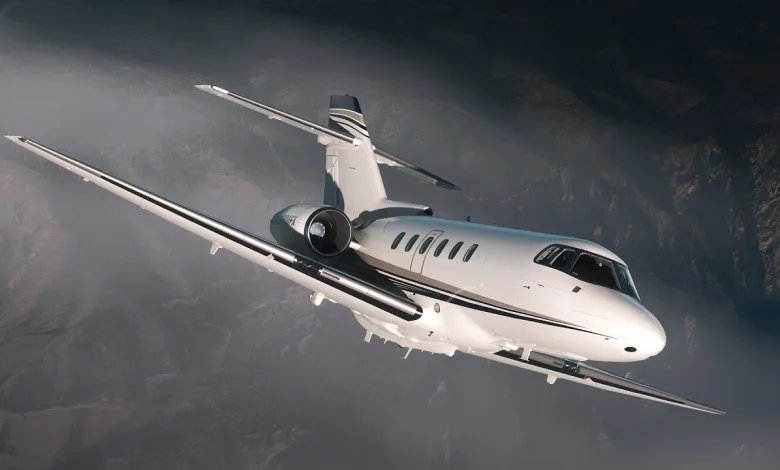
Microsoft Flight Simulator 2024 now has a new business jet to add to its hangar. FlightFX’s Hawker 800XP is available exclusively through the Marketplace for $36.99, with a 2-person crew layout, seating for up to 10 passengers, and a systems package that reaches well beyond the exterior model, according to the official Hawker 800XP announcement.
The real-world Hawker 800XP entered commercial service in 1995 after Hawker Beechcraft developed the 800 line from the British Aerospace BAe 125. FlightFX’s version keeps the midsize twin-engine design and its high-altitude performance focus, with a 2,450-mile range, a 41,000-foot service ceiling, and a climb rate of 3,100 feet per minute.


Two Honeywell TFE731-5BR turbofan engines produce up to 4,660 pounds of thrust each. The aircraft cruises at 460 miles per hour and reaches a top speed of 525 miles per hour. Its simulated flight model uses documented performance tables and includes lift dump, rudder bias, a stick shaker, a stick pusher, and wing-flex physics.
A flight model with working aircraft systems
FlightFX has built the aircraft around more than basic flight controls. The Hawker 800XP includes interactive access panels, pre-flight covers, ground equipment, a recreated cabin and cockpit, and recorded audio from Boris Audio Works. A 6-axis body and seat inertia system responds to turbulence, windshear, touchdown forces, stall buffet, ground roll, and high-G maneuvers. Turbulence response also uses a calculated eddy dissipation rate.
Engine behavior receives its own layer of detail. The simulated DEEC system manages the TFE731-5BR’s fuel consumption, acceleration, overspeed protection, and overtemperature protection. Pilots can use thrust reversers, automatic power reserve, engine synchronization, and an optional autothrottle connected to VNAV and flight-phase detection. Each engine can also develop different relationships among fuel flow, N2, N1, ITT, and oil cooling as its hours accumulate.
Fuel, electrical, hydraulic, pneumatic, pressurization, and ice-protection systems are all modeled. The fuel system supports cross-feed balancing and interactive refueling, while the hydraulic system covers landing gear, flaps, airbrakes, nosewheel steering, lift dump, and the stick pusher. TKS anti-ice fluid is consumable, visible on the wings, and refillable through the cabin service port.
Flight planning tools sit inside the EFB
The Electronic Flight Bag brings system synoptics and flight-planning tools together. It supports Navigraph charts with SimLink, Microsoft Flight Simulator’s LIDO chart service, and SimBrief flight-plan synchronization with the FMS and load manager. Pilots can also use an OpenStreetMap-based moving map with the active avionics route, a satellite view, weight-and-balance controls, and ground equipment controls for the GPU and refueling truck.
Avionics features include a weather radar with tilt control, an MFD map with geographic borders and city labels, custom FMC pages, takeoff and landing performance calculators, a G-force-aware flight director, and normal, abnormal, and emergency checklists.
Each airframe can retain its own state
Persistence is another major part of the aircraft package. The EFB can track and store more than 1,300 parameters for each airframe, including switch, lever, button, door, and drawer positions. Fuel, weight and balance, hydraulic-fluid quantity, de-ice fluid, and per-engine Hobbs time can also carry over between flights.
A saved shutdown state can restore the aircraft for a cold-and-dark start, while runway and airborne starts do not inherit that state. FlightFX’s Hawker 800XP is part of Microsoft Flight Simulator’s Exclusive Series and is sold only through the Marketplace.
Tell us what you think about FlightFX’s Hawker 800XP in the comments, and follow us on X, Bluesky, YouTube, Instagram, Steam, and Telegram.