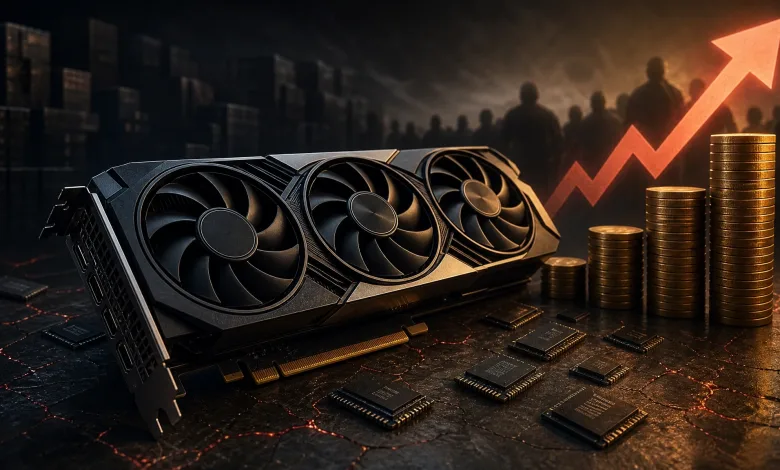
Nvidia graphics cards have entered a rough new pricing phase, and the RTX 5070 is the clearest warning sign. The card’s lowest tracked price rose from roughly $550 to $755 by August 14, putting Nvidia’s GPUs with more than 8GB of VRAM in a difficult position for anyone watching their budget.
The issue is not that extra VRAM suddenly stopped helping games. The problem is that Nvidia’s larger-memory cards are now asking buyers to pay far more for performance that can be found elsewhere for less.
The RTX 5070 has climbed far beyond its earlier price
A previous warning about Nvidia pricing amid VRAM supply strain pointed to possible increases of up to 30%. The latest retail check is already worse for the RTX 5070: its earlier $550 low was followed by a $700 listing that went out of stock, while the cheapest available card found on August 14 cost $755. Most other listings were around $800.
That move from $550 to $755 works out to roughly a 37% increase, beating the earlier 30% forecast. The RTX 5060 Ti 16GB has also reached $650, reversing the odd situation in which the RTX 5070 was priced below Nvidia’s lower-tier 16GB model.
At those prices, Nvidia’s mid-range cards are drifting into territory that used to belong to much faster hardware. Memory supply pressure linked to data-center demand, along with buyers using GPUs for local AI models, has added strain to the market. Whatever the mix of causes, the result for PC builders is the same: cards with more VRAM are becoming much harder to recommend when their prices rise this sharply.
AMD has more room in the budget
AMD’s current options offer a much less painful comparison. The 12GB Radeon RX 9070 GRE was available for $500 and delivered performance close to the RTX 5070 in the cited testing, with FSR4 helping in supported games. The 16GB Radeon RX 9070 was priced at $650—the same as the RTX 5060 Ti 16GB—and performed better in the benchmark results.
In Black Myth: Wukong at 1440p High with quality upscaling, the RX 9070 averaged 111 frames per second with a 96 FPS 1% low. The RTX 5070 reached 107 average FPS and an 81 FPS 1% low, while the RX 9070 GRE posted 95 average FPS and an 82 FPS 1% low.
The comparison is not a claim that every Nvidia card should be ignored forever, or that 8GB is the right amount of memory for every future game. It is a warning about the prices being asked right now. Paying $755 to $800 for an RTX 5070 makes little sense beside a $500 RX 9070 GRE or a $650 RX 9070, especially when the AMD cards offer 12GB and 16GB of VRAM respectively.
If Nvidia’s prices settle back down, the calculation could change. Until then, buyers who care about getting the most gaming performance for their money have good reason to look below the 8GB threshold on Nvidia’s lineup—or consider AMD before handing over nearly $800.
Would you still buy an RTX card at these prices? Share your thoughts in the comments, and follow us on X, Bluesky, YouTube, Instagram, Steam, and Telegram.