War Thunder’s August Decal Hunt Will Open With Ten New Challenges
The tasks will run from August 10 at 11:00 GMT through September 10 at 09:00 GMT, and every decal can be earned with Rank III or higher vehicles.

War Thunder will open its August monthly decal event on August 10 at 11:00 GMT. Players will have until September 10 at 09:00 GMT to complete ten tasks, with every challenge requiring a Rank III or higher vehicle. Gaijin Entertainment’s Steam announcement details the markings and the history behind them.
After July’s batch of clowns, skulls, and squadron emblems, the new set moves across Japan, the USSR, the United Kingdom, Finland, China, France, the United States, Poland, Germany, and Italy. The history behind several of these decals is almost as interesting as the grind needed to unlock them.
Japan and the USSR lead the August decal lineup

Fuji Training Brigade, 4th Company Emblem “Kabuki Kūgā”
Task: Defeat 40 players using Japanese Light Tanks.
This rare marking belonged to the 4th Company of Japan’s Fuji Training Brigade. The Infantry Training Regiment was formed on January 25, 1968, while the 4th Company was established later. After the brigade’s Armored Transport Unit was disbanded, its personnel and vehicles moved to the newly created 4th and 5th Companies on March 26, 1988.
The company operated the Type 96 Wheeled APC, which crews nicknamed “Cougar.” That vehicle inspired the emblem’s large cat, whose red Kabuki-style facial pattern forms the number four. The marking was placed on the rear sides of company vehicles, with the cougar’s head facing forward.
Personal Marking of Vladimir Astakhov, 120th IAP
Task: Finish in positions 1–3 three times using Soviet Aircraft.
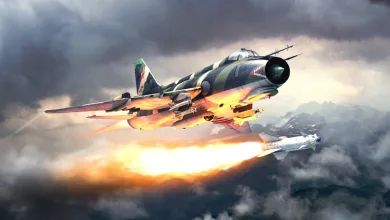
The second decal is based on the personal marking of Major Vladimir Astakhov of the 120th Guards Fighter Aviation Regiment. On September 26, 1988, Astakhov and his wingman Gavrilov scrambled to intercept Iranian air targets. Relying only on radar, both pilots fired an R-24R radar-guided missile at Iranian helicopters from roughly 7 kilometers away and shot them down.
Captain V.P. Maksimenko designed Astakhov’s marking to commemorate the victory, drawing from Western aircraft nose art and a taxidermied vulture given to the regiment by a neighboring helicopter unit. The bird carries an R-60 in the design rather than the R-24R used in the interception. It was painted on the port side of Astakhov’s MiG-23MLD, number 58.
Three more decals cover Britain, Finland, and China
“Casual” Inscription
Task: Earn 15,000 score while using British Ground Vehicles.
British Army crews often gave tanks names beginning with their squadron’s assigned letter. In this case, the letter was C, although there was no army-wide rule governing the practice. Crew members usually chose the names themselves, giving the markings a small window into the personality of each vehicle’s crew.
“Casual” was painted on the central storage bin on both sides of a Chieftain taking part in exercises in Germany with the British Army of the Rhine during the 1980s.
3./HLeLv 24 Emblem (Late)
Task: Defeat 50 players using Finnish or Swedish Aircraft.
This rare emblem belonged to 3. Lentue, Hävittäjälentolaivue 24 of the Finnish Air Force. In 1944, the squadron moved from the Brewster Model 239 to the Bf 109 G as the older aircraft struggled against newer Soviet machines. Finnish pilots used the Messerschmitt effectively, recording a kill ratio of almost 30:1 during the rest of the war.
The squadron usually used a black lynx, but this more abstract design appeared after the transition to the Bf 109. It was reportedly painted on only a small number of aircraft. One clear example appeared on the rudder of Bf 109 MT-437, initially flown by Staff Sergeant Leo Ahokas in June 1944.

Zhu De Inscription
Task: Finish in positions 1–5 five times using Chinese Ground Vehicles.
The Zhu De inscription, 朱德号, honors the commander-in-chief of the People’s Liberation Army at the time. Its story reaches back to 1947, when the East China Field Army captured several American M3A3 Stuart light tanks during the Lunan Campaign.
When the Field Army created its first tank unit in March 1947, its lead vehicle, tank No. 102, received the Zhu De designation. During the Huaihai Campaign, the tank absorbed thirteen direct hits while protecting wounded comrades under heavy fire. The honor later passed to successive tanks operated by the same unit. This particular inscription appeared on the turret sides of a Type 59.
French and American markings bring two aviation histories
Flottille 14F “Le Corsaire” Emblem
Task: Play 20 battles using French Aircraft with at least 60% Battle Activity.
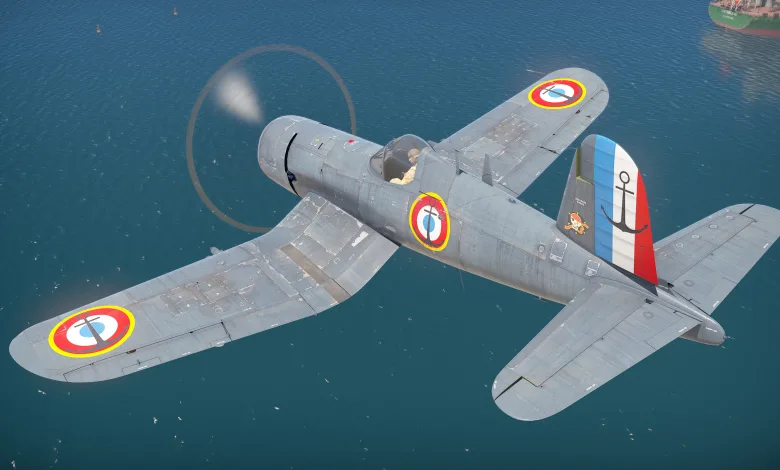
Flottille 14F of French Naval Aviation was formed on January 15, 1953, at La Karouba Air Base in Tunisia. It became the first group to receive the F4U-7, a version built specifically for France and the first new aircraft delivered to the French Navy after World War II.
The flotilla operated the F4U-7 until 1964 and saw action during the First Indochina War in 1954 and the Suez Crisis in 1956. Its pirate emblem came from the aircraft’s Corsair nickname. The design appeared on the middle of the F4U-7’s tail before later moving to a shield under the cockpit of F-8E Crusaders and the leading edge of Super Étendard tails.
2nd Infantry Division Emblem
Task: Defeat 50 players using American Tanks.
The U.S. Army’s 2nd Infantry Division was formed in France on October 26, 1917, making it the first American division created overseas during World War I. Its famous “Indian Head” design followed in 1918.
Lt. Samuel Swift first noticed the distinctive markings on French vehicles while collecting a truck convoy and suggested creating an insignia for his own unit. Lt. Col. William Herringshaw then organized a design contest within the 2nd Supply Train. The winning concepts, a Native American head and a white star, were combined into the emblem that later appeared on many division patches.
Armored vehicles did not usually carry the standard division emblem, but units under the division used Native American imagery in personal markings, including on Sherman tanks during World War II and the Korean War.
Poland, Germany, and Italy close out the set
14 Wielkopolska Brygada Pancerna Emblem
Task: Win 15 battles using Ground Vehicles.
The 14 Wielkopolska Brygada Pancerna, or 14th Greater Poland Armored Brigade, began as the 3rd Brigade on December 12, 1944, before taking its 14th designation on March 8, 1945. It never entered combat. Instead, the brigade trained in Egypt during the final phase of World War II and later served with the Allied occupation force in Italy.
Its training vehicles included M4 Shermans, M3 and M5 Stuarts, and M3A1 Scout Cars. The emblem changed from an elephant to a panther and mainly existed as a shoulder patch. Had the brigade entered combat, the design likely would have appeared on the front and rear left fenders of its tanks.
3. SFltl Emblem “Fliegender Fisch”
Task: Score 20,000 damage using German Coastal Vessels.
The flying fish belonged to S 31 of the 3. Schnellbootflottille, or 3rd Fast Boat Flotilla, of the Kriegsmarine. S 31 primarily laid mines along Malta’s northern coast and near the approaches to La Valletta.
On the morning of May 10, 1942, S 31 struck a friendly mine after several minefields overlapped because of a planning error. The boat was destroyed, while S 61 helped rescue the few survivors. The wreck remains off Malta at a depth of around 60 meters and is still visited by technical divers. The flying fish was painted on both sides of the hull beside the bridge.
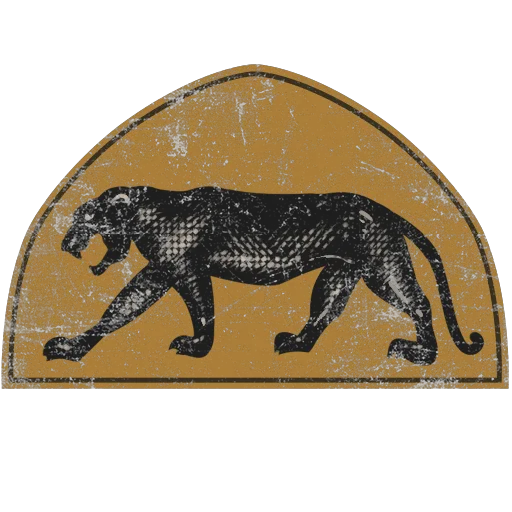
155° Gruppo CB Emblem
Task: Destroy 30 Ground or Water targets using Italian Aircraft.
The 155° Gruppo Caccia-Bombardieri, or 155th Fighter-Bomber Squadron, was formed on January 15, 1941, as the 155° Gruppo Caccia Terrestre. It recorded 127 aerial victories by the end of World War II.
The panther marking came later, during the group’s time operating the F-104. Italian crews called the aircraft the “Bara Volante,” or “Flying Coffin,” and the 155th lost five F-104s during its service. Most of those losses resulted from bad-weather accidents rather than aircraft faults. The emblem appeared near the engine intakes while the group was stationed at Istrana Air Base.
Where to track the monthly decal tasks
During the event, the markings will appear in the Monthly Decals tab at the bottom of the customization menu. After the event ends, each decal will move to its corresponding category.
Players can check the exact requirements and monitor progress through Player Profile > Decals > Monthly Decals. Select a decal and click Track progress to follow its task from the hangar.
Which August decal will you chase first? Share your thoughts in the comments, and follow us on X, Bluesky, YouTube, Instagram, Steam, and Telegram.
War Thunder
Developed by Gaijin Entertainment
War Thunder is a free-to-play vehicular combat MMO featuring aircraft, ground vehicles, and naval craft spanning from the early 20th century to the modern era. Players progress through technology trees across multiple nations, unlocking increasingly advanced military vehicles. The game offers three realism tiers for each vehicle type: arcade, realistic, and simulator modes. Originally developed as a flight simulator under the name "World of Planes," the game expanded to include tanks in 2014 and naval forces later, becoming a combined-arms experience. A mobile version was released in 2023.
- Genre Shooter, Simulator, Tactical
- Platforms Xbox Series X|S, PlayStation 4, Linux, PC (Microsoft Windows), PlayStation 5, Mac, Xbox One
- Perspective First person, Third person, Virtual Reality
- Modes Single player, Multiplayer, Co-operative, Massively Multiplayer Online (MMO)
- Release January 28, 2013
- Publisher Gaijin Entertainment
-
Age Rating