Palworld 1.0 Has Great Creature Systems, but Still Feels Pulled in Two Directions
Pocketpair's full release landed on July 10, 2026, with satisfying Pal management and breeding set against weaker building, exploration, and tonal choices.

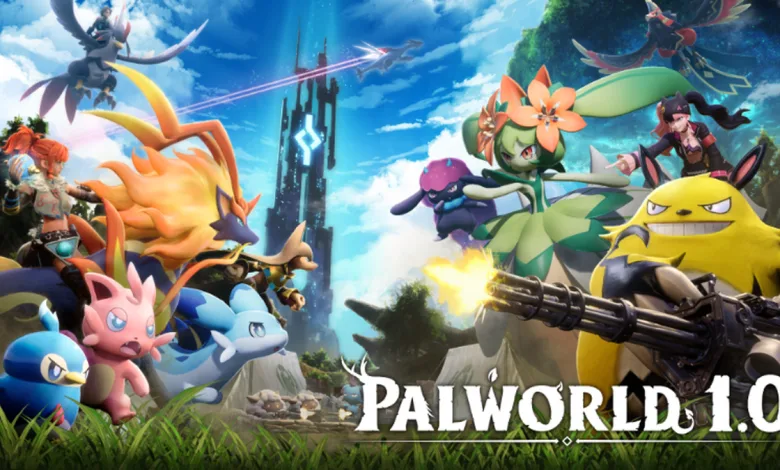
Palworld left early access on July 10, 2026, and its 1.0 version has a clearer foundation than the familiar “Pokémon with guns” shorthand suggests. Pocketpair’s survival game still borrows recognizable creature-collecting ideas, but its best systems come from putting those creatures to work, taking them into battle, and breeding them for specific roles.
The result is a game with a very good creature-collection core and a less convincing survival-crafting shell. Palworld is available on Steam, and the PC version is Steam Deck Verified.


A creature collector with useful Pals
Palworld’s strongest idea is its workforce system. After catching a Pal, players can inspect its work suitability and assign it to jobs around a base. The process is easy to understand, and the creatures generally get on with their tasks without demanding constant correction.
Work suitability levels show what each Pal can do, from planting and gathering to crafting, transporting, and generating power. A creature may look perfect for one assignment but prove less useful than another Pal with a wider set of skills. That gives base management a satisfying layer of decision-making without forcing players into complicated calculations.
The system also leaves room for deeper planning. Partner skills, passive abilities, and breeding can turn a Pal toward combat, crafting, travel, or support. Players can ignore much of that during the main story, then return to it when they want stronger teams or more efficient bases.
Breeding gives the roster extra depth
Breeding is where Palworld’s collecting loop becomes much more than a checklist. Wild Pals can have different genders and passive traits, while Lucky Pals offer the game’s version of shiny creatures. Building a better team may require repeated captures, a Breeding Farm, an Egg Incubator, a Ranch for special ingredients, and a Pal Condenser for combining weaker duplicates.
There is plenty to chase, including specific passives, better statistics, alternate Pals, and Mutated Eggs. The game does not demand that every player use these systems. A team caught in the wild can carry much of the story, but the breeding tools are there for anyone who enjoys perfecting a roster.
That flexibility also applies to combat. Pals can fight alongside the player, provide partner abilities, or serve as mounts. Aerial combat becomes especially useful in tougher encounters, and riding a flying Pal while firing from above feels more connected to Palworld’s central idea than simply carrying a gun through every fight.
The survival side feels undercooked
Base building is functional, but it lacks the creativity found in the better survival-crafting games. The building grid is large and strict, which can force players to use oversized structures. Bigger Pals may also clip through walls unless rooms are built with several layers of height.
There are some welcome tools. The paint system can change the color of certain building pieces and storage items, while an alignment tool makes it much easier to place walls and furniture neatly. Still, several basic furnishings cannot be painted, and the overall building kit leaves too much empty space.
Exploration has a similar problem. Palworld offers a large world and plenty of places to visit, but its scenery and open-world activities do not always match the quality of the creature systems. The adventure is at its best when it sends players after a new Pal, a difficult boss, or a better mount.
A strange tone that does not always land
Palworld repeatedly tries to separate itself from other creature collectors with guns, meat cleavers, cages, and deliberately grim jokes. Those ideas can be funny in small doses, but the game sometimes presents them with an awkward insistence that feels less like satire and more like a reminder that it wants to be edgy.
The meat cleaver is a good example. It can be used on Pals, but early in the game the process is more theatrical than useful. Other moments, such as injured workers and captive creatures, add to the uncomfortable tonal mix without giving the world a stronger identity.
Palworld’s visual direction also struggles to settle on a consistent mood. Some Pals and environments look great, yet the humor and presentation can undercut them. The game has more interesting ideas in its systems than in its attempts to shock the player.
A strong foundation that needs more confidence
Palworld’s 1.0 release provides an enjoyable creature-collection adventure for players who like catching, assigning, fighting, riding, and breeding their team. The game lets players engage with those systems at their own pace, which makes it easy to enjoy without mastering every detail.
Its weaker areas are just as clear. Building is limited, exploration can feel empty, and the game’s personality often depends on cartoon violence rather than a confident sense of style. The creature mechanics deserve to be the center of attention, but Palworld sometimes distracts from them with jokes and ideas that do not land.
The full launch still gives Pocketpair a sturdy base for future updates. Palworld does not need to imitate Pokémon more closely or push its darker humor harder. Its most appealing identity is already visible in the way Pals work, fight, travel, and grow alongside the player.
Have you played Palworld’s 1.0 release? Share your thoughts in the comments, and follow us on X, Bluesky, YouTube, and Instagram.
Palworld
Developed by PocketPair

Palworld is a multiplayer open-world survival game that combines creature-collecting with crafting, base-building, and combat. Set on the Palpagos Islands, players capture and tame animal-like creatures called Pals, which can be used as mounts, combat partners, or workers at player-built bases. The game incorporates firearms and darker satirical elements into the monster-taming formula.
- Genre Shooter, Role-playing (RPG), Hack and slash/Beat 'em up, Adventure, Indie
- Platforms Xbox Series X|S, PC (Microsoft Windows), PlayStation 5, Mac, Xbox One
- Perspective Third person
- Modes Single player, Multiplayer, Co-operative, Massively Multiplayer Online (MMO)
- Release July 10, 2026
- Publisher PocketPair
-
Age Rating