Microsoft Flight Simulator 2024’s Boeing 707-320C Is Available Now for $14.99
Famous Flyer 10 includes three historically accurate navigation setups, a virtual flight engineer, water-injection takeoffs, and Career Mode support.

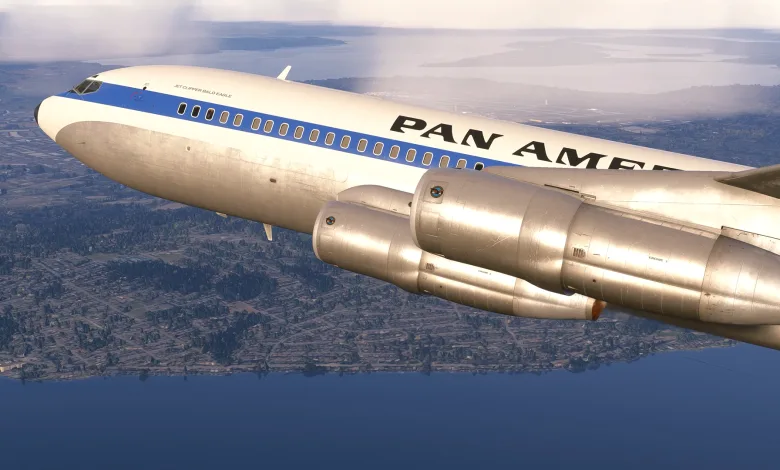
Microsoft Flight Simulator 2024 has added the Boeing 707-320C as its tenth Famous Flyer aircraft. The detailed jetliner is now available through the in-sim Marketplace for $14.99, with the package developed jointly by Microsoft partners iniBuilds and Working Title. Microsoft’s official announcement outlines an aircraft built around period-specific systems as well as optional assistance for pilots who want a lighter workload.
The 707-320C is the final version of the Boeing 707 family and was designed as a convertible airframe. It could carry passengers, freight, or a combination of both, and the simulator version recreates that flexibility with an operable main-deck cargo door, visible containers, working galleys, cabin service areas, and multiple cockpit layouts.

A jetliner that helped define the Jet Age
Boeing introduced the 707-320C during the early 1960s as an improved version of the 707-320B. Its most obvious change was the large fuselage cargo door, while the wings received three leading-edge flaps to improve takeoff and landing performance.
The -320C became the most numerous 707 variant, with 337 aircraft manufactured. Northwest, Pan Am, Air France, and Braniff operated the type around the world. Production continued until 1978, and some aircraft remained in service into the early 21st century.
Its story began with Boeing’s 367-80 demonstrator, better known as the Dash 80, which made its first flight on July 15, 1954. The first 707 production model, the 707-120, followed with a maiden flight on December 20, 1957, before entering service with Pan American Airways on October 26, 1958.
The real 707-320C used a three-person crew consisting of a captain, first officer, and navigator. It could carry up to 219 passengers, 13 pallets of cargo, or a mixture of both. Four Pratt & Whitney JT3D low-bypass turbofan engines produced as much as 19,000 pounds of thrust each. The aircraft measured 152 feet, 11 inches long, stood 42 feet tall, and had a wingspan of 145 feet, 9 inches. Its range reached 3,337 miles with maximum payload or 5,700 miles with maximum fuel, while its cruise speed was 604 miles per hour.
Three cockpit setups cover several eras of flying
Famous Flyer 10 includes three historically accurate navigation configurations, letting pilots choose how much of the 707’s original workload they want to manage.
- Carousel IV-A INS: The classic inertial navigation system includes alignment, position drift, waypoint handling, in-flight position updates, and drift correction.
- UNS-1 FMS: This setup provides RNAV support for current routes and procedures.
- Garmin GNS 530: The GPS unit offers a simpler navigation option and reflects equipment still carried by some 707s in service.
The Carousel IV-A can be aligned in realistic, fast, or instant modes. A realistic alignment takes more than 10 minutes, while the shorter settings let pilots get airborne sooner. Drift can also be disabled for a simpler flight.
The physical unit could store only nine waypoints at once. The included Virtual Navigator can import a route from the flight planner and keep the INS supplied with waypoints throughout a flight, while manual coordinate entry remains available for pilots who want to handle the process themselves. Optional procedure imports also allow SIDs and STARs to work with the INS, even though the original system was designed mainly for ocean crossings.
A Virtual Flight Engineer handles guided flows, voice assistance, and optional automation from cockpit preparation through shutdown. Engine start remains in the pilot’s hands until the starter and fuel controls are ready; once the engines are running, the system can manage tasks such as pressurization and fuel-tank switching. Switches, knobs, and checklist callouts respond as the flows progress, giving the cockpit a sense of activity without taking command away from the pilot.
Systems, controls, and cockpit details
The aircraft’s EFB companion application is built into the Microsoft Flight Simulator 2024 EFB system. It covers aircraft configuration, door controls, performance calculations, INS tools, and other operating tasks alongside the simulator’s checklist, loader, and flight-planning apps.
Pilots can choose how much assistance they want from several realism settings. Automations can handle fuel-temperature management, air sources, EPR bug positioning, fuel balancing, and tank selection. Other options affect the altitude selector, SID and STAR imports, the chronometer, HSI behavior, parking brake operation, window shades, and flight engineer callouts.
The performance tools calculate takeoff and landing data, including V-speeds, stabilizer trim, runway requirements, EPR targets, landing reference speeds, and field lengths. When supported, those values can transfer directly to the aircraft instruments.
Several behind-the-scenes systems are modeled as well:
- Engine and APU bleed air, turbo compressors, pneumatic ducting, air-conditioning packs, and coolant air systems.
- Cabin pressurization, outflow valve operation, landing mode, and cabin altitude behavior.
- Multiple generators, external power, battery buses, APU generation, bus-tie logic, and essential power distribution.
- Flying elevators and flying ailerons, where the pilot moves small control tabs and aerodynamics move the larger surfaces.
- Period-appropriate autopilot and flight director modes for heading, navigation, approach, altitude hold, and navigator-coupled operation.
- Directional gyro behavior, earth-rate and transport drift, synchronization, magnetic following, manual correction, and a backup compass.
The Bendix RDR-1 weather radar includes a functional tilt control and a wide horizontal sweep. Its display shows precipitation in white against a green screen, matching the presentation of one of the earliest airliner weather radar systems.
The cockpit chronometer also follows its original design. It runs from a spring rather than a battery, lasts eight days on a full winding, and includes its elapsed-time and setting functions. For hot or high-elevation departures, the optional water-injection system adds the JT3D-3B’s wet-takeoff behavior, including finite water reserves, realistic thrust and EPR changes, and the black smoke trails associated with those takeoffs.
A combi interior with working ground operations
The model recreates the 707-320C’s mixed passenger-and-cargo arrangement. A main-deck cargo section sits between the cockpit and the aft passenger cabin, with forward and rear galleys, lavatories with opening doors, working cabin lights, and manual or automatic window shades.
The cargo hold contains visible containers, while two courier or cargo-master seats sit forward of the freight section with configurable occupancy. The main cargo door opens, and the galley service door uses the full airline-cart dimensions of the real aircraft. On the ground, passengers board through the rear cabin stairway, lower baggage compartments open beside the main deck, and chocks, service equipment, animated doors, and other turnaround interactions are included.
Exterior details include the low fuselage, tall landing gear, 35-degree wing sweep, four underwing JT3D engines, ventral fin, and fin-tip HF antenna probe. The engine model also includes the JT3D’s inlet guide vanes, blow-in doors, and turbocompressors on three engines. Parked pilots can move the controls and see the small tabs deflect; in flight, the main surfaces follow those inputs through aerodynamic force.
Famous Flyer 10 supports Career Mode and virtual reality
The Boeing 707-320C works with Career Mode, virtual reality, the Microsoft Flight Simulator 2024 EFB workflow, and the simulator’s aircraft interaction systems. That combination gives pilots the option to run a period-style flight by handling navigation and systems manually, or to rely on selected automations while keeping the aircraft’s core procedures intact.
For $14.99, Famous Flyer 10 brings one of aviation’s most recognizable early jetliners into the simulator with passenger, cargo, and combi operations available from the same aircraft.
If you take the 707-320C across the world, share your thoughts in the comments and follow us on X, Bluesky, YouTube, Instagram, Steam, and Telegram.