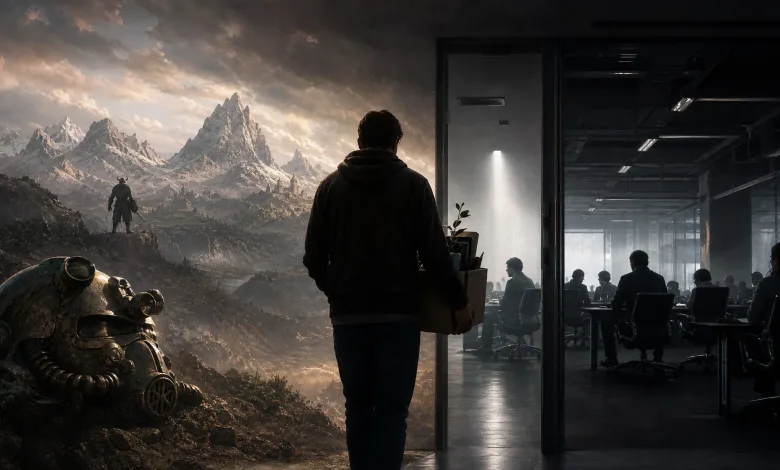
Bethesda’s biggest franchises did not provide job security after all. Xbox’s latest cuts reached the studio anyway, eliminating at least 1,600 of the 3,200 jobs covered by the plan, including staff with decades at Bethesda. Remaining reductions are planned by the end of Xbox’s 2027 fiscal year, and the damage extends beyond a single round of headcount changes.
Anne Barrett, who worked at Bethesda Game Studios Austin, told The Guardian that employees saw Skyrim and Fallout as a kind of job security. “We thought we were safe,” she said, pointing to Bethesda’s established franchises and major projects in development. Instead, some staff were placed in two-minute Teams meetings that ended decades of service at the studio.


In at least one of those meetings, a studio manager read a prepared statement while employees could not speak or react because their cameras and microphones had been disabled. Workers were warned that their Slack access would soon be removed. Goodbye messages appeared in Slack before access to the channel was shut off, adding another abrupt end to careers that had often lasted for years or decades.
News of the cuts arrived with almost no internal warning. Employees were following the same public reports about possible layoffs as everyone else, then saw Xbox CEO Asha Sharma’s July 6 memo, “resetting Xbox”, published for the world to read. About an hour later, workers entered meetings where they learned who had been let go.
Barrett said she initially laughed through the day because she could not believe the cuts were happening. The loss sank in the following day, after seven years at Bethesda and a lifelong ambition to work there. She also described coworkers breaking down as they struggled to understand what was happening.
Bethesda’s future pipeline made the layoffs even harder for employees to understand. Fans have waited well over a decade for The Elder Scrolls 6 and Fallout 5, two long-awaited RPGs at the center of the studio’s future. Bethesda later said most of its development staff were focused on The Elder Scrolls 6, while Fallout 5 was in preproduction.
Veteran knowledge is part of the cost
The restructuring also reached ZeniMax Online Studios, id Software, and Bethesda Game Studios Montreal. At id Software, 136 employees were cut, reportedly representing most of the studio’s workforce. VFX artist Derek Best described the result as leaving the creator of Doom and Quake closer to a support studio.
Bethesda Game Studios suffered a different kind of loss, with veteran developers carrying years or even decades of knowledge leaving in a single afternoon. Alex Nguyen, a union bargainer who remains at Bethesda Game Studios Dallas, said colleagues lost their positions despite strong performance and long records of contribution. The result is a break in institutional memory at the same time that the company expects its remaining teams to keep developing large and complex games.
Barrett’s concern was not simply that fewer people would be available to work on future games. Bethesda’s proprietary technology and recognizable visual identity were built and maintained by specialists whose knowledge cannot be handed to new hires overnight. Replacing staff does not automatically preserve the decisions, tools, and production habits that took 15 or 20 years to develop. “You can’t just throw new people at that problem, right?” she said.
The personal cost has also been immediate. Morgan Goin of ZeniMax Online Studios described checking whether there was enough food and water for the day after losing work. Simon Préfontaine, a single father who worked at Bethesda Game Studios Montreal, lost both his income and health insurance. He also described former colleagues who had spent more than a year searching for new jobs.
Bethesda Game Studios employees formed a union after the layoffs, while Bethesda and ZeniMax unions continued effects bargaining with Microsoft over severance packages. Rallies were held outside studio buildings across North America. Microsoft said its offer included up to 39 weeks of pay and six months of company-paid health coverage, while the union said the proposal had not gone far enough to address the consequences facing affected members.
OneBGS has also shared interviews with affected developers across social channels, giving more staff a way to discuss what happened after their jobs ended.
AAA ambitions meet shorter financial cycles
The criticism extends beyond headcount. Barrett argued that AAA games earned their value through the creative resources large studios could support, not only through scale or visual polish. Repeating familiar formulas, pushing more projects toward live-service models, and relying on safe sequels can leave players with fewer reasons to trust the next major release.
Recent history has given players plenty of reasons to be cautious. Cyberpunk 2077 had been in development since 2012 before launching in a broken state, while Battlefield 2042 followed with its own troubled release a year later. Fallout 76, Overwatch 2, and Mass Effect Andromeda also became part of a wider conversation about big-budget games failing to match what players were promised at launch. In some cases, years of updates were needed to move those games closer to their intended condition.
Nguyen’s proposed answer is less dramatic than another round of expansion. Publishers need to accept that modern AAA projects can require multi-year development cycles, then adjust their scope or financial expectations to match. If a project cannot support its cost and timeline, scaling it back or making fewer blockbuster games may be more realistic than demanding yearly returns from a product that takes many years to build.
The industry’s current squeeze followed rapid growth during the pandemic and the assumption that this level of expansion would continue. When that expectation failed, studios reduced headcount quickly. Developers who had built the tools and workflows behind major franchises were among those removed, even though their experience was part of what made those teams work.
At least 1,600 additional cuts remained ahead under the Xbox reset. Projects tied to those teams could face delays, reduced scope, or cancellation. Even when a project survives, losing the people who built its technology and understood its creative identity can leave a hole that takes years to fill.
Barrett’s concern goes beyond the loss of individual jobs and unfinished projects. She also said the layoffs damaged her view of the wider game industry, arguing that AAA games were valuable to players because their resources could support creative work, not simply produce larger versions of the same formula. For Bethesda employees who believed its best-known franchises would offer some protection, the cuts delivered a very different message.
The contrast between decades spent building Bethesda’s identity and meetings that lasted only minutes is difficult to miss. Share your thoughts in the comments, and follow us on X, Bluesky, YouTube, Instagram, Steam, or Telegram.