Assassin’s Creed’s Modern-Day Story Has Lost Its Way
Black Flag Resynced's strong launch has renewed attention on a franchise narrative that keeps resetting its modern-day storyline.

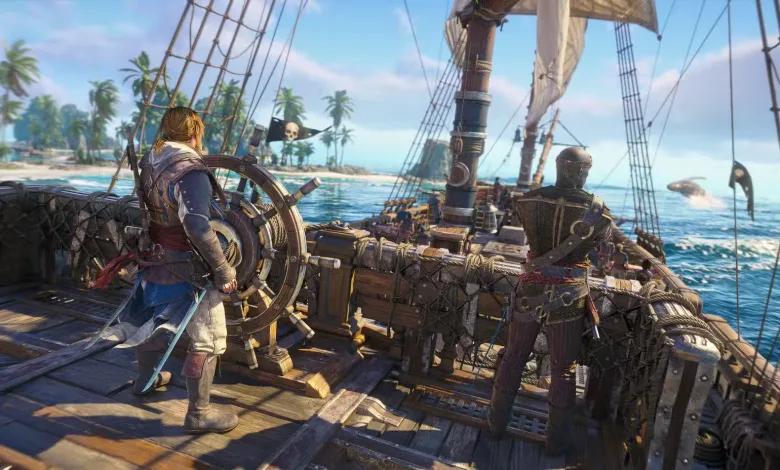
Assassin’s Creed: Black Flag Resynced launched on July 9, 2026, and has already sold more than three million copies worldwide. Much of the conversation around the remake has centered on Edward Kenway, naval combat, sea shanties, and Ubisoft’s cosmetic DLC choices. The game’s success has also brought an old problem back into focus: what is the series actually trying to do with its modern-day story?
Black Flag Resynced uses the same Animus Hub opening seen in Assassin’s Creed Shadows. The sequence presents itself as an Abstergo training video before it becomes corrupted by a digital voice warning that the player is being lied to and welcoming them into “the dark.” Used once, the scene may come across as an intentionally ominous setup. Repeating it without a clear narrative payoff makes the broader story feel even less connected.

That issue matters because the modern-day plot has been restarted several times since Assassin’s Creed III. Each new attempt has introduced fresh characters and lore, but later games have often moved on before those threads received a proper conclusion. Important developments have also been placed in journals and Codex entries, leaving players to reconstruct the larger story outside the main campaign.
Assassin’s Creed Has Spent Years Rebuilding Its Modern Story
The early games followed Desmond Miles as he used the Animus to experience the lives of historical assassins. His sacrifice was meant to give humanity a chance against the Isu threat posed by Juno, but Black Flag moved away from that structure.
Instead, players took control of an unnamed Abstergo employee. The character had little personality and mainly served as a way to explain the Animus, Abstergo’s manipulation of historical memories, and the company’s efforts to find powerful artifacts. The game eventually offered a choice to expose Abstergo’s secrets, but the decision had little effect on the games that followed.
Ubisoft later tried to give the modern-day sections more direction through Layla Hassan. The period covering Assassin’s Creed Origins, Odyssey, and Valhalla gave the series a recurring protagonist, but it also added more mythology and Isu lore to an already complicated narrative.
In Odyssey, Kassandra becomes immortal after using the Staff of Hermes, an artifact connected to Atlantis and the Isu. Valhalla reveals that Eivor is connected to Odin, while the Aesir gods are presented as an Isu faction and Yggdrasil is reinterpreted as a machine preserving consciousness. The game also brings back Kassandra, introduces Desmond as “The Reader,” and adds the strange half-digital, half-spiritual realm known as “The Grey.”
Assassin’s Creed Mirage adds another layer by revealing that Basim is the reincarnation of Loki. Each idea can work in isolation, but together they create a story that asks players to remember a large amount of lore without offering a clear destination.
The Animus Hub Has Not Solved the Problem
Ubisoft introduced its Animus Hub in 2022 as a new entry point for the franchise. Marc-Alexis Coté, then vice president and executive producer of Assassin’s Creed, said players would not need to know who Desmond or Layla were. The stated goal was to place the player at the center while allowing the games to focus more heavily on their historical settings.
That approach can make individual campaigns easier to follow, but it also leaves the modern-day plot in an awkward position. The hub suggests that the games are part of one connected narrative, while the story content itself often feels detached from one release to the next.
During a BAFTA event in London in 2024, Coté acknowledged that the series had struggled to build a meaningful connection between its historical settings and modern day. He described future themes involving memory, identity, autonomy, and the way control over the past could affect the future in comments reported by Eurogamer.
Those themes could provide a strong foundation, but the franchise has repeatedly asked players to wait for that foundation to become a complete story. After enough resets, some players may no longer want to invest in another long-running mystery.
Should the Series Leave the Modern Day Behind?
There is a reasonable case for reducing the modern-day sections to a framing device. The historical settings are usually where the series finds its clearest identity, while the modern plot has become harder to follow with every new layer of Isu mythology.
A distant future could offer another option. A science-fiction setting far removed from the present might give Ubisoft room to build a new conflict around surveillance, identity, and control without forcing the story to connect every new development to Desmond, Layla, or an earlier Animus mystery. That would be a major change, though, and there is no indication that Ubisoft has announced such a direction.
For now, Assassin’s Creed Shadows appears to keep the modern-day material mostly in Codex entries and later additions. That may suit players who prefer the historical campaigns, while longtime fans who still care about the larger narrative are left searching for evidence that the next chapter will actually follow through.
Black Flag Resynced’s early sales show that interest in the franchise remains strong. The open question is whether Ubisoft can give that audience a modern-day story worth following, or whether the series should finally stop pretending that every historical adventure needs to connect to one.
Do you still care about Assassin’s Creed’s modern-day storyline, or should Ubisoft leave it behind? Share your thoughts in the comments, and follow us on X, Bluesky, YouTube, and Instagram.