AMD’s rumored Gainsborough APU has picked up more circumstantial support, but no confirmed Steam Deck 2 specification exists. An AMD driver listing includes Gainsborough and ATLite3, while a shipping-manifest reference has prompted speculation that silicon validation may be underway. Neither clue confirms the hardware inside the shipment or establishes a Steam Deck 2 release window.
Gainsborough’s name also fits the Steam Deck’s existing codename trail. The original handheld’s SoC was called Aerith, whose full name is Aerith Gainsborough. That resemblance is a useful naming clue, but it does not prove that Gainsborough is a successor’s chip.

Moore’s Law Is Dead ties Gainsborough to the Steam Deck 2 in its latest video. The chip is reportedly being designed for TSMC’s N3P process, which would be a major move from the 7nm process used for the original Steam Deck’s Aerith APU. A newer process could improve power efficiency, an important consideration for a battery-powered system, although it does not establish how long a future device would last on a charge.
The same rumor points to AMD’s Zen 6 CPU architecture and RDNA 5 graphics. Those details suggest a new hardware generation, but no specific Gainsborough core count or GPU compute-unit count has been reported.
A separate rumored AMD chip, Canis, offers a possible point of comparison rather than a Steam Deck 2 spec sheet. Canis has been linked to Sony’s next handheld and is said to include four Zen 6c CPU cores, two low-power Zen 6 cores, 16 RDNA 5 compute units, and a 192-bit memory bus. The report suggests Gainsborough could have a similar configuration, but does not confirm that it will.
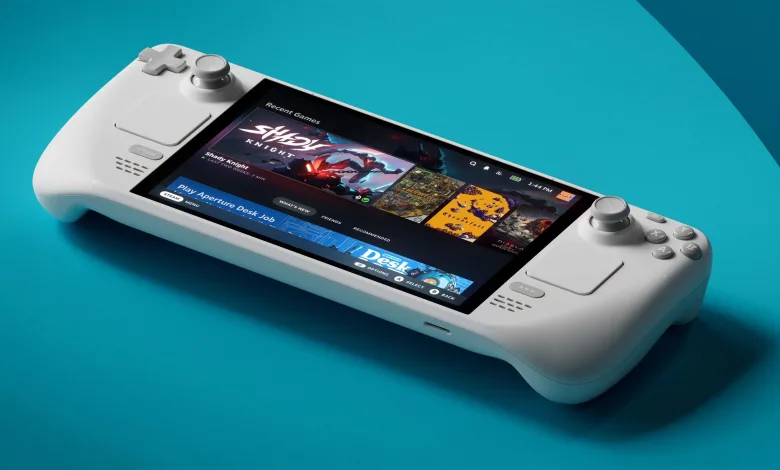
For scale, the original Steam Deck’s Aerith APU and the slightly revised Sephiroth chip in Steam Deck OLED each use eight RDNA 2 compute units. A hypothetical move to 16 RDNA 5 units would double that count while changing the graphics architecture, but the rumor provides no Gainsborough figure to support that as an actual Deck 2 configuration.
ATLite3 is separately being linked to the rumored Orion SoC for the PS6. The theory partly draws on a 2019 leak that used the name Navi 10 Lite for the PS5 GPU, but shared Lite wording is a naming clue, not proof that ATLite3 belongs to Orion or that Orion is the PS6’s final SoC name.
Moore’s Law Is Dead puts Gainsborough’s readiness in late 2027 or early 2028. That is a reported timeline for the APU, not a launch window for a handheld, and Valve has not announced when a Steam Deck 2 will arrive.
What kind of performance and battery-life gains would make a Steam Deck 2 feel like a true next-generation handheld? Follow us on X, Bluesky, YouTube, Instagram, Steam, and Telegram.