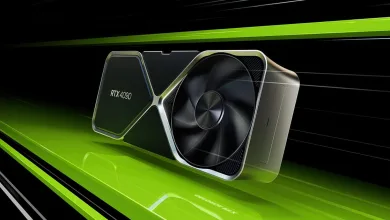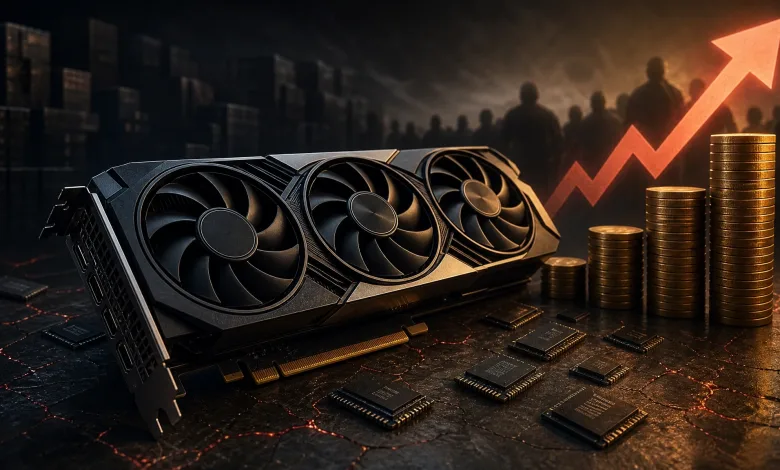
Nvidia graphics cards could become even more expensive after a Taiwanese report claimed the company is raising prices for GPU bundles by 20% to 30%. The reported increase covers both the graphics processor and its attached memory, including cards using GDDR6 and GDDR7.
Economic Daily News reported that distributors in China are panicking and becoming reluctant to sell while they assess the higher costs. The report does not confirm that retail prices in every region will rise by the same amount, but board partners would have little reason to absorb a large increase in component costs.
The report also reportedly covers Nvidia’s entire graphics-card lineup rather than only premium models. That would put additional pressure on buyers across multiple price tiers, including products using both newer GDDR7 and older GDDR6 memory.
Insider Gaming reported that Nvidia had already notified graphics-card manufacturers about the potential pricing change, although Nvidia had not publicly confirmed an increase as of July 30, 2026.
Industry analyst Harukaze5719 estimated the Chinese-market RTX 5090 D at $3,843 and the RTX 5080 at $1,845 in the current pricing environment. The latter is already close to the launch MSRP of the RTX 5090. The RTX 5090 had also been linked to a price increase in May, meaning the latest report could point to Nvidia’s third increase this year if the information proves accurate.
Harukaze5719’s market estimate adds to a difficult picture for PC builders. The reported figures apply to the Chinese market, so they should not be treated as a direct price list for retailers elsewhere.
Other reported prices also illustrate how much the market has changed. Insider Gaming reported that the RTX 5090, which launched at $1,999, was selling for roughly $3,999 to $4,500, while the RTX 5060 Ti had reportedly risen from $379 to $569. Those figures are reported market prices rather than a universal Nvidia retail price list.
VRAM costs remain at the center of the problem
Graphics card pricing is being squeezed by the cost and availability of VRAM. Memory chips have become harder to source as prices continue to rise, putting pressure on both Nvidia and the companies that turn its GPU kits into finished graphics cards.
The incoming report attributed some of that pressure to rising demand from AI companies and data centers, which are buying memory and other hardware faster than supply can meet demand. Nvidia remains one of the largest companies in that AI hardware market, adding to the broader competition for components.
That pressure helps explain why AMD launched a 4 GB RX 9050, while memory manufacturers such as SK hynix and Samsung have reported record profits. Lower-memory products can reduce component costs, although the tradeoff is less room for high-resolution textures and demanding games.
Rumors late last year suggested Nvidia could stop bundling VRAM with its GPUs. That approach might reduce one burden for Nvidia, but board partners would still need to secure memory on their own. Smaller manufacturers and companies focused on cheaper cards could face the hardest time if supply remains tight.
For shoppers, the immediate takeaway is simple: a rumored supplier-side increase does not automatically become a 20% or 30% jump at every store. It does mean that upcoming graphics card deals may be harder to find if distributors and board partners pass the extra cost along.
Share your thoughts on the reported Nvidia price increase in the comments, and follow us on X, Bluesky, YouTube, and Instagram for more PC hardware news.