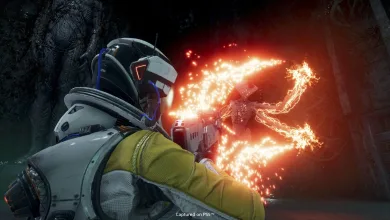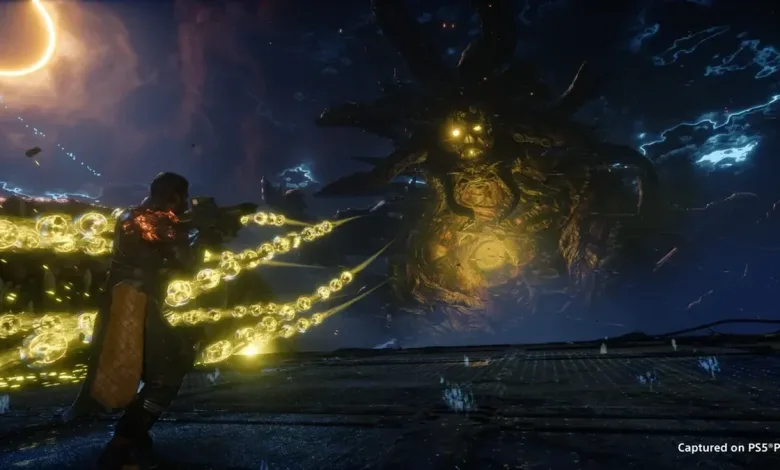
In Saros, Carcosa’s soundscape has to do more than make the hostile world feel strange. Enemy calls and projectile effects are designed to help players read danger when the screen fills with attacks. An October 27 PlayStation Blog breakdown explains how the audio team built that combat language while giving the game its own sonic character.
The team carried forward an emphasis on gameplay feedback from Returnal, but used the Eclipse as a starting point for Carcosa’s sound. Recordings of a didgeridoo, transformed through audio processing, became part of the Yellow King’s voice and the wider Corruption palette. The cinematic announcement trailer was the public’s first chance to hear those experiments.


Other sounds began with less obvious sources. Processed floppy disk recordings helped build the first mechanical drone players encounter. For the ocean in the Yellow Shore, the team recorded marinated and frying chicken, along with walnuts moving in a bowl. Composer Sam Slater’s score adds distorted voices, synthesis, guitars, and darker textures. Mongolian throat singing forms part of the cosmic enemies’ vocal foundation, with shakuhachi and higher vocal elements adding contrast.
Enemy sounds and projectiles carry combat information
Organic, mechanical, and cosmic enemies each belong to a distinct sonic family. Their vocalizations are meant to be quick and recognizable, particularly when an attack needs to be dodged or absorbed with a shield. Projectile sounds have separate palettes too. Blue effects draw on electric and liquid textures, yellow Corrupted projectiles use the didgeridoo-based Corruption language, and red projectiles incorporate tonal material derived from processed human screams.
To keep those signals audible amid Housemarque’s dense projectile patterns, the mix gives enemies different levels of prominence based on threat, distance, visibility, and combat state. Projectiles are grouped by type and proximity. The goal is to preserve the sounds that help players react, rather than simply silencing everything else.
Spatial audio and haptics add another layer
Tempest 3D Audio is meant to communicate position as well as atmosphere. Enemies and projectiles can approach from above, below, behind, or outside the screen, so directional sound can help players locate threats during a fight. Saros also uses PS Acoustics, a technology from PlayStation’s Audio Tools and Tech team that uses ray tracing to calculate reverberation, reflections, obstruction, and occlusion in real time. Sounds from Arjun, enemies, and the Echelon IV crew respond to nearby walls and their materials.
The game was also mixed for Dolby Atmos, carrying its vertical and positional audio design over to speakers. The final mix was completed at Abbey Road Studios. Sound and DualSense haptics were designed together, including a change in haptic frequency as a bullet-based weapon runs low on ammunition. That gives players a subtle weapon-state signal without requiring them to look away from the action.
Players can adjust the mix
Audio settings include Dialogue Priority, which can make dialogue louder or clearer, along with separate control over sound effects and a setting to reduce high-pitched ringing. Players can adjust music independently for combat and exploration, tune bass and treble, and calibrate dynamic range for their listening environment.
Which sound cue would you want to notice first in a crowded fight? For more on Saros’ combat audio and accessibility features, follow us on X, Bluesky, YouTube, Instagram, Steam, and Telegram.
Saros
Developed by Housemarque

Saros is an action game developed by Housemarque and published by Sony Interactive Entertainment. Players control Arjun Devraj, a Soltari Enforcer investigating a lost off-world colony on Carcosa. The game features fast-paced third-person combat, boss encounters, and progression across repeated attempts.
- Genre Shooter
- Platforms PlayStation 5
- Perspective Third person
- Modes Single player
- Release April 30, 2026
- Publisher Sony Interactive Entertainment
-
Age Rating