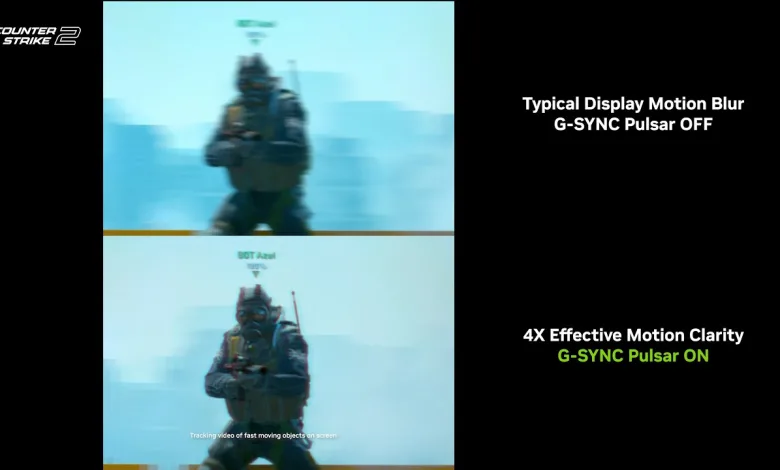
Nvidia showed an updated version of G-Sync Pulsar at CES 2026 that changes how backlight strobing is applied to reduce perceived motion blur in fast-moving games. The company demonstrated a method that pulses a small horizontal section of the backlight ahead of the monitor’s scanout rather than stroking the whole panel between frames.
How the new Pulsar works
The new approach, called Regional Backlight Pulsing, divides the backlight into ten strobable horizontal “stripes” and pulses whichever stripe the monitor is actively scanning out. That lets the strobe follow the frame as it rolls down the screen, instead of flashing the entire backlight all at once.

Nvidia says this makes each frame visible for roughly 25% of the frame time, which the company describes as producing “4x smaller object hold time” and “4x the effective motion clarity” compared to having Pulsar off. Those are vendor claims, but the tech is clearly aimed at competitive FPS play, which is why the demos used Counter-Strike imagery.
Pulsar builds on the idea behind Ultra-Low Motion Blur, but adapts it to variable refresh rates so strobing and VRR play nicely together. For a quick primer on the base concept, see Nvidia’s Ultra-Low Motion Blur writeup. The first monitors announced with the new Pulsar mode are 27-inch, 360 Hz, 1440p IPS panels from Acer, AOC, Asus, and MSI. That product mix signals Nvidia is pitching the feature at esports-focused displays rather than high-refresh extremes like 540 Hz panels.
Real-world results will depend on implementation, personal tolerance for strobing, and whether games and drivers cooperate without introducing flicker or other artifacts. Still, the regional strobing idea is a clever solution to a long-standing problem… it targets only the area of the backlight that matters at any moment instead of throwing the whole panel into darkness between frames.
Stay connected with updates on display tech and esports through our social channels: X, Bluesky, YouTube, Instagram.