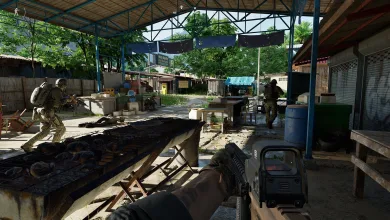
Gray Zone Warfare’s Rogue Ops update is now live on Steam for PC. The October 22 release adds a Hideout, crafting, and contraband operations, as confirmed in MADFINGER Games’ official launch announcement. The partial wipe clears locker contents and money but preserves completed tasks, rank, unlocked apparel, vendor levels, and statistics. Returning players must also make an irreversible choice about whether their existing progression transfers to PvE or PvEvP. MADFINGER detailed those changes in its Update 0.5 devlog, with a later content breakdown filling in more of the weapons, locations, and task details.
MADFINGER describes Gray Zone Warfare’s broader direction as moving beyond a Mil-Sim toward a Merc-Sim. Realistic combat, survival, healing, and weapon building remain part of the game, while Rogue Ops gives the PMC role a more explicit economic dimension through technology salvage, drug production, and faction work.
Gray Zone Warfare’s previous wipes arrived alongside major updates: Night Ops in November 2024, Winds of War in May 2025, and Spearhead in April 2026. That history points to resets tied to major releases, not a fixed calendar.
MADFINGER has moved Gray Zone Warfare from pre-alpha into alpha. The studio says its content pipeline is 30% complete against the game’s full vision, a figure shown in promotional material behind closed doors at Gamescom. Hideouts and crafting had been identified as 0.5 plans in March, before the update had a release date.
Four characters and a progression split
Accounts can hold up to four characters, each assigned to a faction and either PvE or PvEvP. Players cannot have two characters with the same mode-and-faction combination at once, and can delete only one character per week. Separate progressions give players room to maintain characters for different modes, but changing a character’s setup will not be a quick reset.
When returning players first enter the Supporter Preview or full release, they must choose which mode receives their Update 0.4 progression. The choice cannot be reversed, and the character keeps its existing faction. The soft wipe removes locker contents and cash while preserving completed tasks, rank, unlocked apparel, vendor levels, and statistics. The Supporter Preview was scheduled to begin on October 19, and its progress carries into the full release on October 22, as outlined in the preview announcement.
A hideout with competing routes
Players receive a home in Lamang with specialized rooms, including a Laboratory, Electronics Workshop, and Utility Room. The Laboratory supports medical supplies and narcotics production, turning the Hideout into more than a storage area and giving players new ways to build cash and faction relationships.
Drug production splits into competing routes. Players can work with Lab Rat to supply clinics and struggling facilities with morphine, or join Vulture to produce and distribute harder narcotics such as heroin. The black-market route can improve a player’s standing with Vulture while costing reputation with Lab Rat. Banshee offers another option by sending players after people carrying narcotics through Lamang.
A Micro Lab adds another branch to Hideout progression. Players can break down abandoned technology and relics found in the open world, then work with Artisan to put the recovered technology to constructive use or partner with Turncoat to sell it on the black market.
MADFINGER describes these activities as the second of three gameplay loops planned for Gray Zone Warfare. Building cash, technology, and faction relationships will help prepare players for the eventual push toward Ground Zero, while narcotics, black-market technology, and clues tied to the red cloud at the center of the tactical map continue to expand the game’s central mystery. Notes, newspapers, and letters scattered around the world will add to that thread.
New locations and changing routes across Lamang
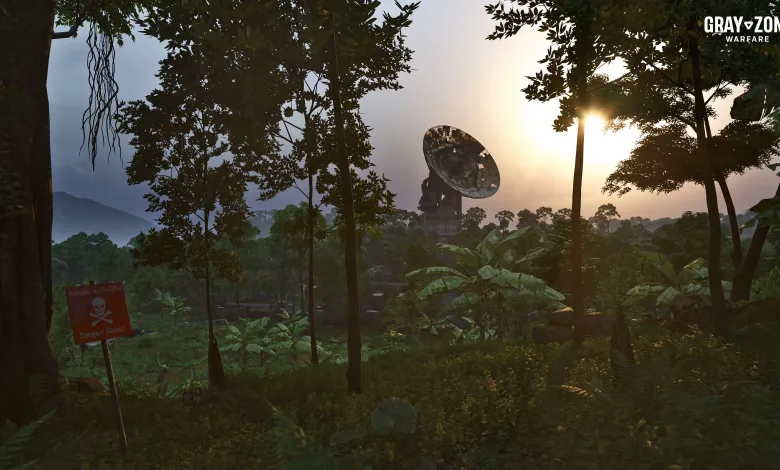
Rogue Ops adds three high-difficulty Tier 4 Points of Interest: Lakevale Sanctuary, also known as the Asylum; Northern Reach, the Military Research Site; and RLSL-1, the Radio Observatory. Lamang also gains 15 or more smaller locations, including jungle drug huts, apartment buildings, villas, Khmer temple ruins, Rocky City, and underground tunnels.
New quests, long-term contracts, traps, puzzles, and interactive objectives give players more to find across the map. New Main Tasks and Long-Term Contracts connect to the Hideout, smuggling, and hunting, while Chameleon magazine tasks add another set of objectives. Hideout resources are scattered around Lamang, and a three-tier hacking tool lets players bypass electronic locks and enter restricted areas.
High-value loot spawns less often. Tracking Tags and Stims have also left vendor inventories and become crafting requirements, pushing more of the supply hunt into the world and the Hideout. Vulture now appears on the standard vendor screen and no longer requires access through a Combat Outpost.
Environmental props and variations of dead bodies strengthen environmental storytelling. Televisions and voice recordings react to player actions, and footsteps sound different depending on the surface. HDR support, improved lighting and clouds, and a polished transition between sunset and outdoor light sources round out the visual changes.
New NPC activity includes smoking, chatting, hanging out, and talking on the phone. New idle animations around points of interest help distinguish ordinary activity from alerted enemies. AI NPCs can bandage themselves, selected factions throw grenades, and enemies make better use of cover. Locations tied to new activities have higher AI respawn rates, while enemies in Tier 3 and new Tier 4 locations are tougher.
The update’s teaser trailer offers a look at the new sites.
Healing will focus on body parts
Medical treatment applies to a body part rather than each individual wound. Multiple broken bones in one leg require a single splint, for example, while injuries to both legs still take two. Bleeding rules limit how quickly an affected part can bleed, giving players a slightly better chance to stop it, and a new visual effect signals bleeding.
Medical supplies have clearer differences in quality, specialization, and use. Higher-quality items treat injuries faster and provide more uses, with military-grade supplies generally outperforming civilian alternatives. Some items work only on certain body parts, so tourniquets no longer apply to the head or torso. Others, such as a surgical kit, can handle several conditions, including broken bones, organ damage, and bleeding. Players can also craft medical supplies in the Laboratory.
Blood bags, bottles, and other healing supplies are measured by volume, with characters consuming only what treatment requires. A clearer health panel and new icons for stim effects make injuries and active buffs easier to read. Stims are no longer sold by vendors and must come from other sources, including crafting.
Audio, animations, and Combat Outposts
Audio changes include story-focused sound design for new locations, new AI voice lines with some performances recorded by Lao voice actors, and sounds for items such as televisions and voice tapes. The M4 and AK weapon families get revised gun sounds, distant gunfire uses an updated sound palette, and spatial audio bugs are fixed. The time limit on Proximity Voice Chat is also removed.
Rogue Ops adds an animated character-selection screen, polishes existing animations, and adjusts healing animations to match the faster use of some medical items.
The largest Combat Outposts temporarily function as regular world locations instead of capturable objectives. MADFINGER says the changes are intended to reduce PvP concentrations around outposts and spread encounters more naturally across the island. Outpost locations have been redistributed.
Weapons and technical updates
Rogue Ops adds seven weapons: the G36, FAMAS, G3, Benelli M4, AUG, UMP, and Glock 18C. The AUG includes the AUG A3. Most of the new firearms are found around Lamang rather than bought from vendors, and rare builds have low drop rates. Weapon placement reflects location, too, with LLA units guarding drug labs carrying different firearms from their counterparts elsewhere.
The detailed 0.5 breakdown lists 370 weapon parts, six unique firearm camo variants, 22 collimators with different color and reticle options, and two magnifiers with 4x and 6x magnification. An earlier broad overview described more than 400 attachments and weapon parts, a combined figure covering a wider category than the 370 weapon-parts count. New parts also expand existing platforms such as the AKS, and each new weapon has its own inspect animation.
Camo colors and patterns are adjusted for Lamang’s environments. Suppression conveys incoming fire without the full-screen blur, and SP and HP ammunition create larger wounds than FMJ and AP rounds. MADFINGER is also optimizing existing weapons and introducing realistic camos.
Behind the scenes, Rogue Ops brings new server infrastructure with stronger anti-cheat measures, further optimization, improved PiP scope performance, and an upgrade to Unreal Engine 5.7. The engine update also improves lighting and clouds.
Would you rather search Lamang for rare weapon builds or rely on crafting for supplies that vendors used to carry? Follow Rogue Ops’ changing loot and crafting routes on X, Bluesky, YouTube, Instagram, Steam, and Telegram.
Gray Zone Warfare
Developed by MADFINGER Games

Enter a high-stakes PvE-first open-world tactical shooter set on a quarantined Southeast Asian island torn apart by faction warfare. Deploy as an elite operator, fight solo or with your squad to carry out missions, earn reputation, and explore the truth behind the Event igniting the conflict.
- Genre Shooter, Simulator, Adventure
- Platforms PC (Microsoft Windows)
- Perspective First person
- Modes Multiplayer, Co-operative, Massively Multiplayer Online (MMO)
- Release April 30, 2024
- Publisher MADFINGER Games
-
Age Rating