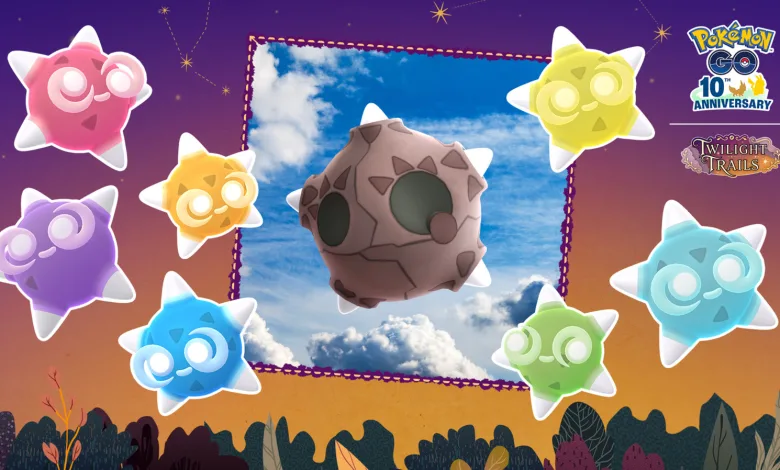
Minior has a credible Great League niche in Pokémon GO, but making it work means managing a one-time transformation. It starts in sturdy Meteor Form, then switches to a much frailer, higher-Attack Core Form when its health falls below half.
JRESeawolf’s PvPoke analysis gives Minior a strong simulated Great League profile, with its best plan built around banking energy before that switch. The results point to potential, not a guaranteed battle script.


Meteor Form gives Minior time to build
Minior’s average Great League stats show the tradeoff clearly. Meteor Form has 98 Attack, 170 Defense, and 137 HP. Core Form jumps to 146 Attack, but falls to 95 Defense and 111 HP. Its Rock/Flying typing brings resistances to Fire, Flying, Ground, Normal, Bug, and Poison, but leaves it weak to Water, Electric, Ice, Steel, and Rock. Steel opponents are especially awkward because they resist both Rock- and Flying-type attacks.
The form change happens automatically below 50% health, though using shields can delay it. The strategy is to stay in Meteor Form while building energy, then switch into Core Form with enough saved to fire off attacks. Opponents can pressure Minior into changing sooner, and the simulations sometimes use charge moves before Minior reaches full energy, so the timing will not always line up neatly in a live battle.
Rollout sets up the charge moves faster
Rollout is the better fast move for this plan. It generates 4.33 energy per turn, compared with Take Down’s 3.0, while Take Down deals more fast-move damage. Both take 1.5 turns. Eight Rollouts build 104 energy on paper, enough to fill the game’s 100-energy cap in 12 turns. Take Down needs 11 uses to reach 99 energy, taking 17 turns.
That difference gives Minior a better chance to bank energy while its Meteor Form can still take hits. It also makes Rollout a more dependable way to prepare for the burst after the form change.
Ancient Power makes the cleaner follow-up
Ancient Power costs 45 energy for 60 damage and has a 10% chance to raise Minior’s Attack and Defense by one stage. Power Gem costs 50 energy for 85 damage, while Acrobatics deals 110 damage for 55 energy. With 100 energy saved, Ancient Power and Acrobatics can be used back to back. Power Gem’s higher damage is tempting, but pairing it with Acrobatics costs 105 energy, so Minior needs another Rollout after switching.
In the 1-1 shield simulation for Ancient Power, Minior picks up wins against Shadow Annihilape, Cradily, and Mimikyu that the Power Gem build misses. With shields down, the Ancient Power results include a win against Feraligatr, while the Power Gem simulation picks up Marowak and Corviknight. Ancient Power is the more flexible pairing for a planned two-move burst, while Power Gem has a case when shields are down.
Ultra League looks much less appealing in the PvPoke matchup simulation. An earlier formula fitted to a different Minior projected a level-74 Meteor Form at Core level 50, but that result remains untested.
Minior PVP Great League and Ultra League Form Change Analysis
byu/Ok_Lobster8494 inTheSilphRoad
A separate Ultra League check recorded Meteor Form at level 55 and 1,837 CP from Core level 32.5 through 34. The two specimens do not establish one progression rule for every Minior.
UL Minior – Caps At Level 55
byu/Zestyclose-Tip-8928 inTheSilphRoad
Have you found a good way to time Minior’s Core Form switch in live battles? For more on its level scaling and Great League matchups, follow along on X, Bluesky, YouTube, Instagram, Steam, and Telegram.
Pokémon Go
Developed by Niantic Labs, The Pokémon Company

Pokémon Go is an augmented reality mobile game that uses GPS to let players locate, capture, train, and battle Pokémon in real-world locations. Players explore their physical surroundings to find PokéStops for items, battle at Gyms for team control, participate in Raid Battles cooperatively, and compete in the Go Battle League's player-versus-player format. The game is free-to-play with in-app purchases and features Pokémon from across multiple generations of the franchise.
- Genre Role-playing (RPG), Simulator
- Platforms Android, iOS
- Perspective Third person, Bird view / Isometric, Side view
- Modes Single player, Massively Multiplayer Online (MMO)
- Release July 6, 2016
- Publisher Niantic Labs
-
Age Rating