Hearts of Iron IV’s upcoming Romania Focus Pack will open with a choice over which half of the country receives government support. Paradox’s Oct. 22 Romania developer diary outlines how that split can steer Romania into alternate-history politics, while leaving the historical path available either way.
The choice reflects Romania’s divided starting position in January 1936. The Old Kingdom covers the country’s pre-World War I borders, while the New Kingdom includes territories gained from Hungary and the former Russian Empire. Their different priorities compete for funding in Bucharest, and an early focus lets players favor one side. That decision determines which alternate-history routes open.
Romania’s competing political routes and the tradeoff between industry and agriculture have been outlined in earlier previews. The new diary ties those branches to Romania’s diplomatic pressures: Bulgaria seeks Dobruja, Hungary wants Transylvania, and the Soviet Union threatens Bessarabia. The Little Entente, Balkan Pact, and a defensive alliance with Poland offer different forms of support against those risks.
Iron Guard power or a path through royal rule
One alternate route builds the Iron Guard’s influence through recruitment and anti-monarchical propaganda, then lets it demand a referendum to end the monarchy. The regime still faces opposition after taking power. A branch led by Corneliu Codreanu can form the Legion of the Archangel Michael and invite other Balkan nations with the same ideology into its faction before pursuing regional dominance.
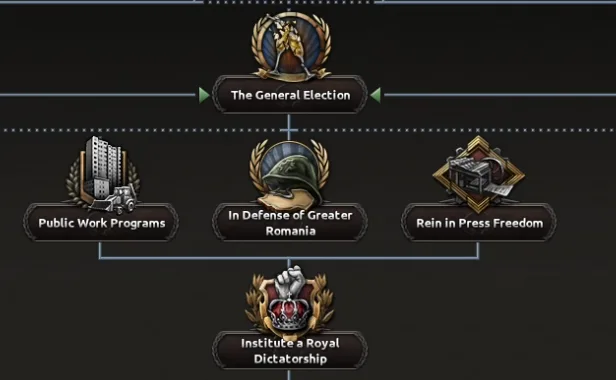
The historical route instead moves Romania from democracy toward an absolute monarchy. Players can reach the General Election focus earlier than the real December 1937 vote, then choose measures such as public works, defending Greater Romania, or restricting press freedom. The Iron Guard becomes a threat to the regime, and players must deal with it before choosing to continue toward German alignment or relax the royal dictatorship.
Following the German-alignment route brings events leading to King Carol’s abdication and the ascension of his son, Michael. Removing remaining Carlist elements comes later. Meanwhile, Romania faces demands for territory from its neighbors. The tree then offers opportunities to recover lost land and protect the Muntenian Oil Fields, which the diary identifies as important to Germany’s war effort.
Romania’s wartime options depend on how the conflict goes. A successful campaign can open a push to press the advantage, while a worsening situation offers a turn west and a government shift instead of an eastward advance.
Two economic routes, two kinds of cost
The diary describes a Romania where 80% to 90% of the population depended on rural agriculture, even as its leaders pushed to industrialize. The shorter Balkan Industrialist path grants industry and production bonuses earlier, leaving more time for diplomacy or other focus branches during the peacetime buildup. Its longer-term economic potential is less assured.
Breadbasket of Europe takes longer to develop. It gives Romania fewer factories directly but adds trade bonuses and building slots, leaving more room to shape the economy. The agricultural route also initially reduces recruitable population, reflecting the strain on farm families when men remained in the army during peacetime. Those debuffs can be removed later.
Which opening would you choose for Romania, support for the Old Kingdom or the New Kingdom? Follow the focus pack’s developing political and economic plans on X, Bluesky, YouTube, Instagram, Steam, and Telegram.