Age of Empires III’s Poles Will Bring Folwarks and Winged Hussars on September 10
The Baltic Powers will introduce a population-driven economy, four signature units, five revolution paths, and a 15% preorder discount.

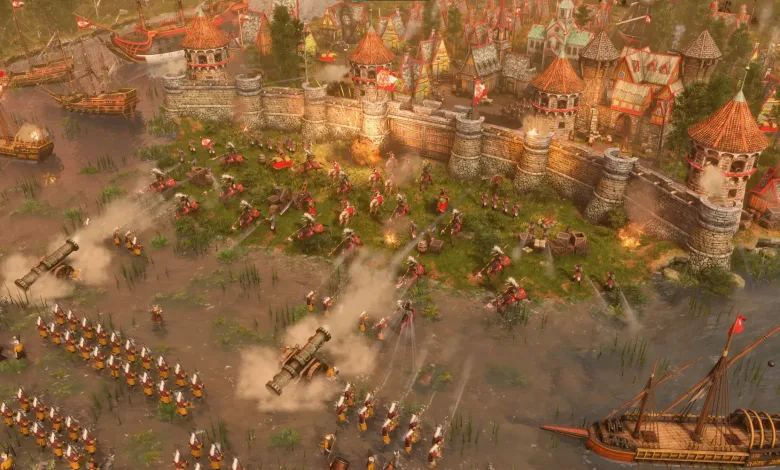
Age of Empires III: Definitive Edition will add the Poles through The Baltic Powers expansion on September 10, 2026. The civilization will center on cheaper, faster construction, specialized Folwarks, a population-based Sejm economy, and hard-hitting cavalry. The official Poles civilization overview also details the faction’s units, cards, and revolution choices.
The Polish-Lithuanian Commonwealth stretched from the Baltic Sea to the Black Sea during the 17th century. Its diverse population, agricultural output, political system, and famous cavalry all feed into the game’s design. Through its connection to the Duchy of Courland, the Commonwealth even had a role in small colonial efforts in the Caribbean.


Polish bonuses reward expansion
Polish players will begin with a Hetman instead of an Explorer. Their buildings will cost less and finish construction faster, although the structures will also be weaker. Walls are the exception and do not receive the lower-cost bonus.
The civilization’s other bonuses connect its economy directly to its military. Unit Shipments will unlock and grow based on the number of buildings in the settlement, while players will also have access to two new Fortress Age Revolutions.
Folwarks and the Sejm drive the economy
The Folwark replaces the Mill and is available from the start of a match. Each one supports five gatherers and provides 10 population slots. Once the second age begins, players can spend wood to specialize each Folwark individually.
Farming Folwarks support more farmers and improve gathering. Livestock Folwarks can train Pigs and fatten livestock, while Military Folwarks add more training capacity for army production. Players can also downgrade and specialize a Folwark again later. The Sich specialization adds defensive tools, including artillery access, more line of sight, garrison space, and healing.
A standard Folwark can train the Retainer, giving the Poles an early defensive or raiding option. Polish Home City reinforcements also become stronger as the total number of Folwarks increases, giving the building a role beyond food production.
The second major Polish structure is the Sejm, which Settlers and the Hetman can construct during the Commerce Age. It combines the functions of the Capitol and Factory, providing earlier access to strong economic upgrades. Its resource generation is tied to the current number of Settlers, so a growing town also improves the building’s output.
Sejm Policies let players select which resource the building produces. Policy upgrades improve both Settler gathering and the chosen Sejm output. In the Industrial Age, the Democracy of Nobles card can reduce the building’s dependence on Settlers by half. The Cossacks Revolution can also allow the military population to contribute to that calculation.
Cavalry leads the Polish army
The Polish roster replaces standard Musketeers and Skirmishers with several specialized units, while cavalry forms the center of the army.
The Hetman is a melee cavalry hero who can collect Treasures and construct Trading Posts, Town Centers, and Sejms. He has no ranged attack, but he moves faster and survives more punishment than an Explorer. His mace also deals area damage during melee attacks.
Starting in the Commerce Age, the Winged Hussar becomes available at the Stable. This elite heavy cavalry unit costs a large amount of resources and population space, but its lance charge counters infantry and deals siege damage. The charge bypasses the usual armor types that protect against ranged and hand damage, and it can hit units positioned behind the primary target.
The lower-cost Retainer is available from both the Stable and the Folwark in the Commerce Age. Its anti-cavalry bonus makes it useful against mounted opponents, though massed ranged fire can bring it down quickly. Retainers are cheap enough to field in large numbers for raids, distractions, or protection for Winged Hussars.
At the Barracks, the Piechur replaces the Skirmisher. It counters every infantry unit but has shorter range than a standard skirmisher. Later upgrades improve that range, while its low hit points mean players will need to keep Piechurs away from enemy melee cavalry.
Cards scale with buildings and population
Polish Home City cards are built around the same economic and cavalry themes. Banner Cards cost coin and send more native auxiliaries for every Folwark owned. Saxon Banner provides Trabants, Royal Banner sends Lipka Tatars and Companions, and Scottish Banner delivers Lowlanders who can fill the role of Musketeers or Dragoons.
Assembly Cards cost wood and send larger groups of units or Settlers as the building count rises. Rzeczpospolita provides scaling Settlers, Robocizna sends laborers to the Folwarks, Pospolite Ruszenie calls in Retainers, and Towarzysze Pancerni sends Cavalry Archers in greater numbers as the town grows.
Several cards are aimed directly at building a Winged Hussar force. Koncerz sends two improved Hussars with stronger and more frequent charges. Polish Cavalry Combat raises the hit points and damage of Winged Hussars and Retainers, while Kircholm Veterans sends three Hussars and researches Veteran status.
Szlachta lowers the cost of Winged Hussars and Cavalry Archers while changing Retainers to a coin cost. Polish Horsemanship speeds up cavalry training, gives Cavalry Archers trample tactics, and unlocks Stampede mode for Winged Hussars.
The economic cards support the same plan. Agrarian Reforms sends a Homestead Wagon and improves food gathering from Folwarks, while Grain Export converts food into coin at 80% of its value and can provide food crates through Farming Folwarks. Advanced Folwarks makes the buildings stronger and cheaper, increases their population space, and sends another Homestead Wagon.
Later options include Krakow Salt Mines, which improves mining and adds food gathering near economic buildings along with two Salt Prospector Wagons. Democracy of Nobles upgrades the Sejm into a Senate that can spawn Cannons and needs only half of the Settler population for resource generation.
Five revolution paths take the Poles in different directions
The full Polish outline names five revolution routes across the Fortress and later ages. Cossack Hetmanate sides with frontier rebels, granting raiding bonuses and large groups of Cossack cavalry while keeping a defensive farming economy. The irreversible route also centers on Outlaws and Folwark spawns.
Livonia aligns the Poles with the Hanseatic League and restores the Order’s military tradition through heavy Teutonic Knights and Mercenaries. Its plan revolves around Knights, Forts, and Heroes, while Settlers remain available and Priests can farm or gather berries.
Duchy of Warsaw moves the civilization toward the Napoleonic era with Polish Legions, artillery, and Factories. It restores access to Musketeers, Skirmishers, and Dragoons, and can provide two Factories alongside the Poles’ strongest infantry and artillery options.
Hungary calls on Hajduk Outlaws and Magyar Hussars, adds cards to the revolution deck, and includes the Honvéd Riflemen. The United States route draws on the legacies of Kościuszko and Pułaski, granting American revolutionary units and allowing Pułaski’s Legion to ship Polish Uhlans.
The Baltic Powers will arrive in September
The Baltic Powers is scheduled to arrive on September 10, 2026. Preorders are currently offered through Steam and the Microsoft Store with a 15% discount.
Which Polish feature stands out most to you: the Folwark economy, the Sejm, or the Winged Hussars? Share your thoughts in the comments, and follow future coverage on X, Bluesky, YouTube, Instagram, Steam, and Telegram.