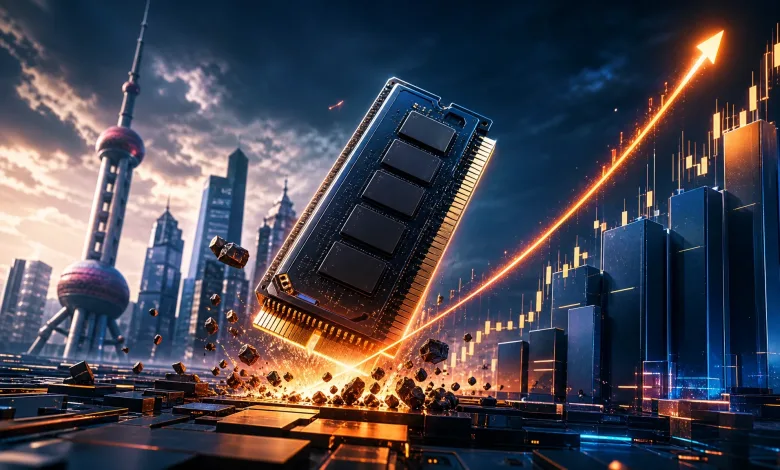
Chinese memory manufacturer CXMT made its debut on Shanghai’s STAR Market on July 27, raising $8.6 billion in Asia’s biggest initial public offering of 2026 so far. Its shares climbed 466% during the first trading session, lifting the company into the upper tier of China’s listed businesses.
CXMT’s market capitalization reached about $487.73 billion after the debut. Tencent remained ahead at just over $500 billion, while CXMT moved above Industrial and Commercial Bank of China by market value, according to Reuters.


The stock closed at 49 yuan after reaching 55.03 yuan during the session. CXMT’s IPO price was 8.66 yuan per share, giving the company a dramatic opening-day gain as demand for memory hardware remains high.
CXMT’s growing role in the memory market
CXMT had already drawn attention for plans to expand its DRAM manufacturing capacity. Several PC component companies have been validating Chinese-made memory, which could give CXMT a larger role in the supply chain if production grows as planned.
The company’s rise also comes as the memory shortage is being driven in part by demand from artificial intelligence hardware. That has fueled strong interest in memory manufacturers, but not everyone expects the current market mood to last.
Yuan Yuwei, a hedge fund manager at Trinity Synergy Investments, told Reuters that CXMT’s stock was “too expensive and smells of speculation.” He also said, “It’s hard to say the optimism is sustainable.”
CXMT still trails the biggest memory companies outside China. SK hynix has a market capitalization above $777 billion, while Micron stands at about $1.04 trillion and Samsung at more than $1.135 trillion at the time of writing.
Micron has also reportedly asked US lawmakers to restrict CXMT’s access to chipmaking equipment, Reuters reported. At the same time, sources told the outlet that Apple had sought assurances CXMT would not be added to the US Department of Commerce’s Entity List, according to a separate report.
For PC buyers, CXMT’s expansion could eventually mean another source of DRAM for memory kits and other components. Whether the company’s market value can stay near its post-IPO level will depend on production growth, demand from AI hardware, and how trade restrictions develop.
What do you think CXMT’s rise means for the PC memory market? Share your thoughts in the comments, and follow us on X, Bluesky, YouTube, Instagram.