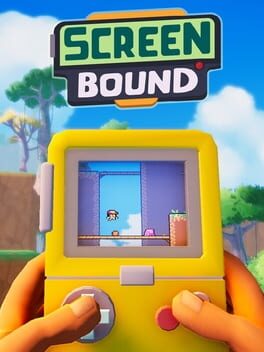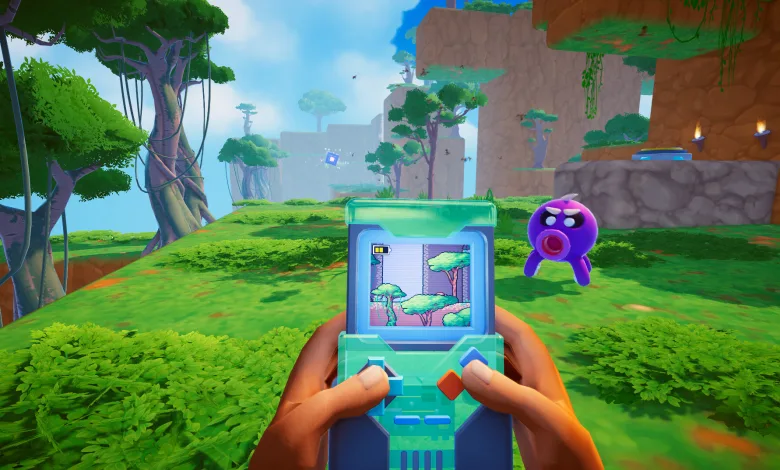
Crescent Moon Games’ Screenbound asks a straightforward question and then makes it complicated: what happens when a 2D platformer and a 3D platformer occupy the same space at once? A GDC demo puts that idea on display by forcing players to read both perspectives at the same time. The setup is simple. The player character finds a handheld device called the Qboy, with a post-it stuck to it that reads “Find Me.” Turning the Qboy on transports the character into a stylized game world of floating islands, chiptune music, and collectible coins. The twist is that the same level exists in two formats simultaneously.
From a first-person viewpoint players look out over a full 3D world. At the bottom of that view the Qboy shows an overlayed version of the level as a flattened 2D platformer. That handheld view functions like a retro screen inside the 3D environment; the preview labels it roughly “2.5D.” That dual presentation is more than cosmetic. The 2D display often offers the clearest path to objectives. Key collectibles or routes that are hidden from a particular 3D vantage become obvious on the Qboy’s screen. Conversely, some obstacles and threats only appear in the 3D world. Players must shift attention between the two constantly to progress.
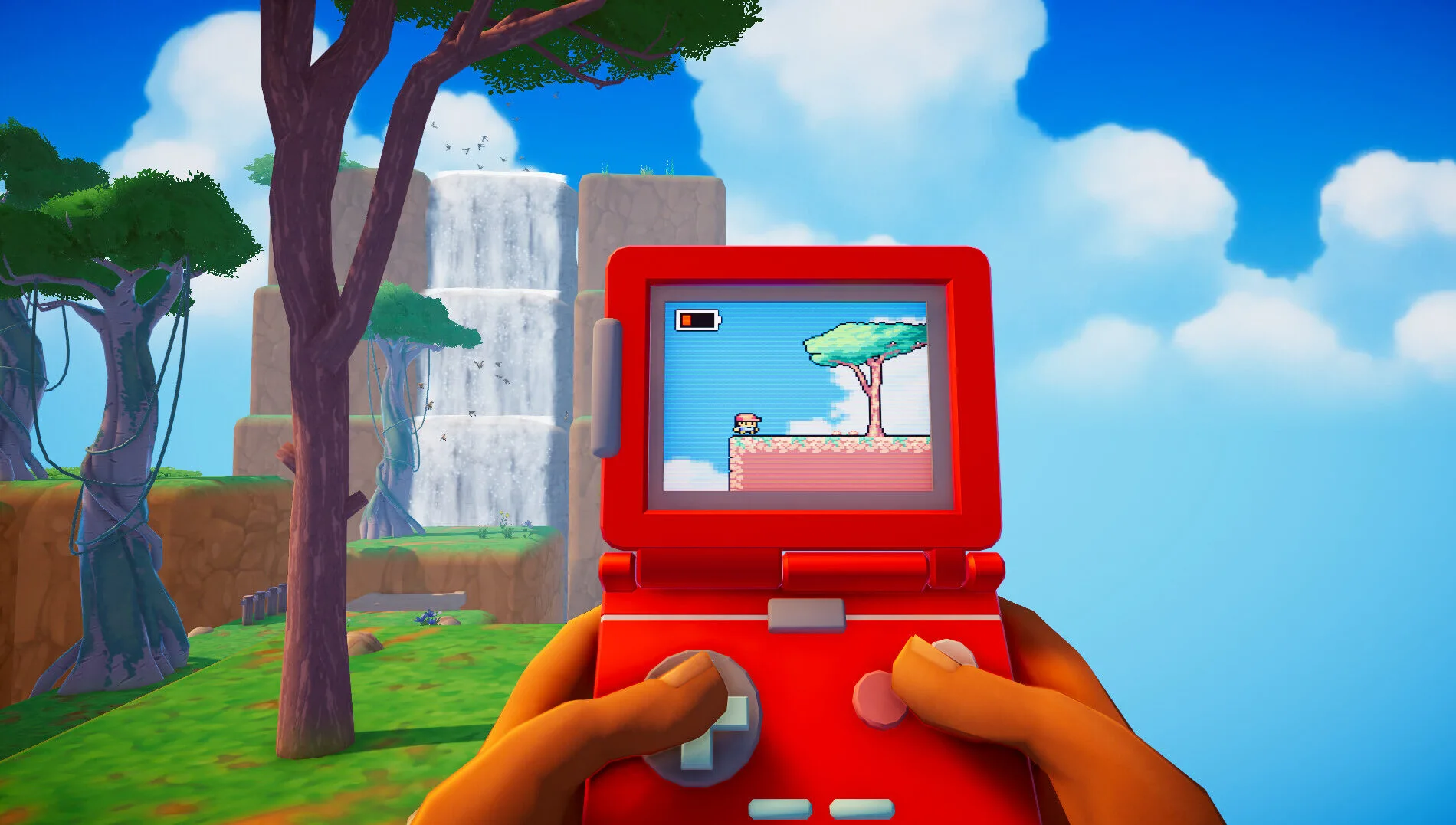
To bridge the gap, Screenbound includes a Q-view mode that translates elements of the 2D screen into the 3D space. Q-view highlights secrets from the handheld’s perspective inside the larger world so puzzles that depend on both views can be solved. Some encounters require this exact coordination: a route blocked in 3D may be cleared by locating and using an item visible only on the Qboy’s 2D screen.
Parts of the game move entirely into 2D. Entering doors or interacting with certain consoles takes players into full side-scrolling sections where classic platforming returns. Those areas can award extra coins, hide Qube collectibles used to unlock bonus levels, and include secret exits that open new zones in the 3D world. Even within the first world the demo introduces a range of new rules. Weapons, block types, and enemy designs are introduced to one or both viewpoints, which means players learn new interactions on the fly. The design pushes players to mentally map how items and mechanics behave in 2D versus 3D.
After the demo finishes a trailer drops a small but important hint: the game refers to the current content as “Cartridge 1.” The trailer implies Screenbound will add further cartridges that change how the game looks and plays, which suggests future unlocks could alter the interplay between its 2D and 3D systems and add more genre twists. Between the Qboy, Q-view, full 2D sections, hidden Qube collectibles, and the Cartridge 1 tease, Screenbound’s early presentation makes clear the project is aiming for layered puzzle-platforming that rewards close attention to both screens.
If the demo is any indication, the game’s mechanics will ask players to keep moving their eyes and their thinking between both worlds. Which cartridge would you want to see next, and what changes to the Qboy would help you solve its puzzles? Share your thoughts in the comments and join us on X, Bluesky, YouTube, Instagram.
Screenbound
Developed by Those Dang Games, Crescent Moon Games