AMD posts a brief clip after a 4,769 MHz Radeon overclock and leaves many questions

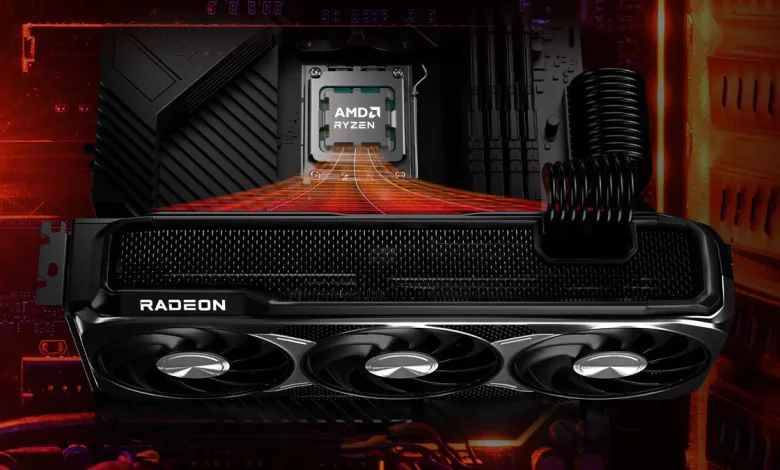
AMD and top overclockers Alverson and Golibersuch published a short video that claims a Radeon RX 9060 XT, the Navi 44 chip, reached 4,769 MHz while cooled with liquid nitrogen. The clip shows the card with its stock cooler removed and a cold sink applied, and it includes a GPU‑Z window, but that GPU‑Z screen identifies a different model in at least one frame.
The report of 4,769 MHz represents a roughly 52 percent bump over the Navi 44 core clock that observers would expect from that family of cards. The video offers no documented testing methodology, no stability benchmarks, and no explanation for why the GPU‑Z overlay at one point refers to an RX 7600 XT rather than the RX 9060 XT that was physically shown. That lack of detail leaves basic questions unanswered about how the clock was measured and how the result was validated.

The short clip appears on one of AMD’s subsidiary YouTube channels and runs without an accompanying press release or mention on AMD’s Newsroom page. The absence of a formal write up or an official ratification spotlights a broader gap in how extreme GPU overclocks are recorded. Unlike CPUs, which have public leaderboards and records on sites such as HWBot, there is no widely recognized, centralized register for GPU frequency world records.
The footage shows the overclocking setup and the overclockers at work. The card was stripped of its stock cooler and mounted to a liquid nitrogen cold sink to reach ultra low temperatures. The two overclockers achieved the 4,769 MHz reading in the video, but the clip does not explain what stopped them from going higher, what workloads were run to test stability, or whether the reported reading was sustained under load.
The piece places the achievement in historical perspective by recalling an overclock from roughly 26 years ago that pushed an Nvidia Riva TNT2 Ultra from its stock 150 MHz up to 190 MHz. That anecdote is used to underline how eager hobbyist overclockers have long been to share extreme frequency gains and why many would expect a company to make more of an occasion out of a record-class result.
Despite the questions, the overclock itself is technically impressive. Pushing a Navi 44 chip to those frequencies while maintaining any level of measurable stability requires skill, specialized cooling, and careful preparation. The lack of formal verification or a public leaderboard means the claim rests largely on AMD’s and the overclockers’ word as presented in the short video.
AMD’s Newsroom page was checked for an official mention and contains no public announcement about the overclocked run. For that reason the HWBot leaderboard link is relevant when discussing how CPU overclocks are tracked and why some observers expect an equivalent for GPUs. See AMD’s Newsroom and HWBot world records for reference.
If you have details or screenshots showing the GPU‑Z readout timing or the test workloads, say so and follow for updates on this topic on X, Bluesky, YouTube, and Instagram.